
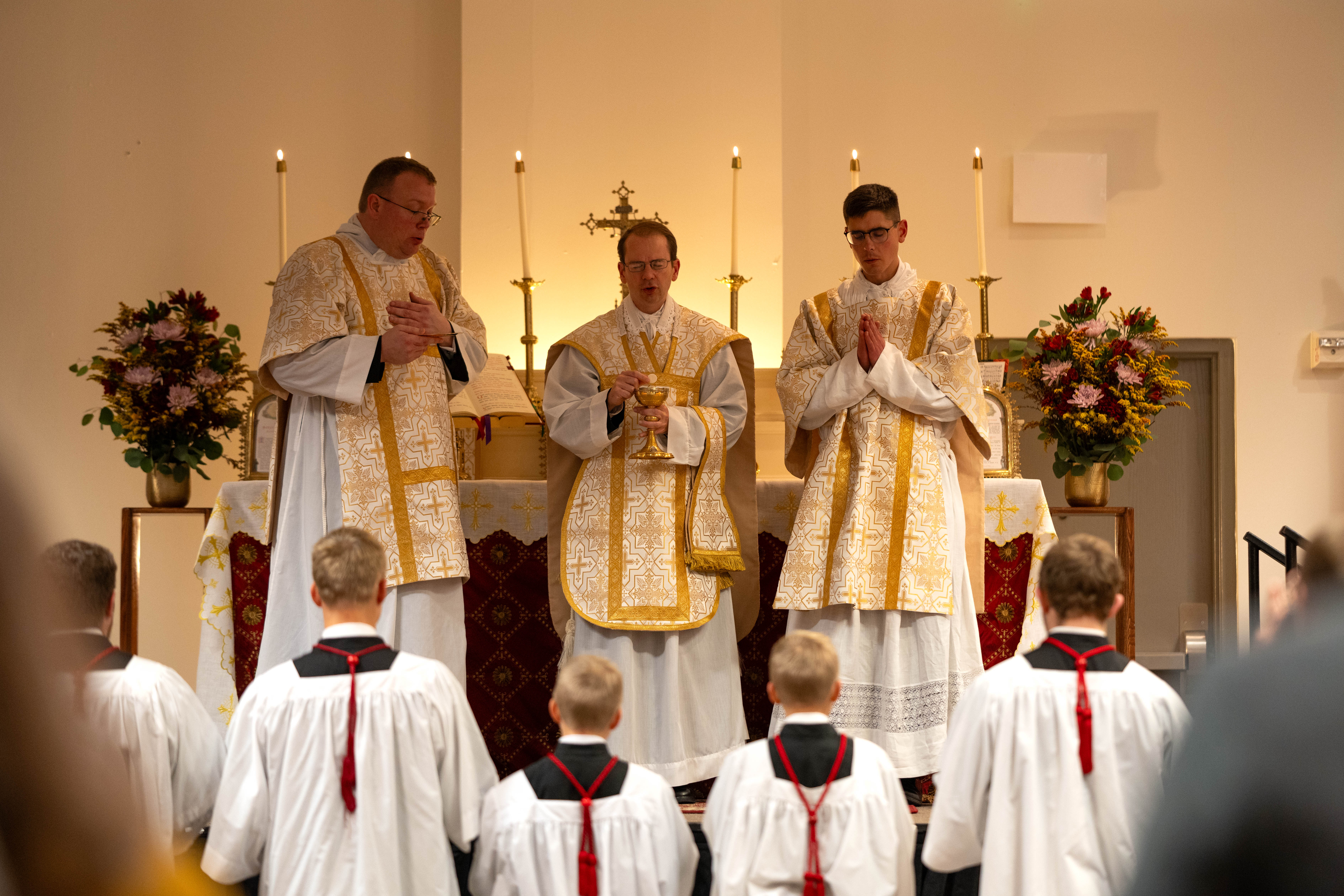
PORTLAND — After a seven-year hiatus, the West Coast Catholic Conference returned on November 13–14, drawing attendees from across Clark County, the Portland metro area, and the broader Pacific Northwest to the Holiday Inn Portland-Airport for two days of historical and philosophical lectures.
Organized by the Holy Name Society of Our Lady of Fatima Church, a traditional Roman Catholic parish of the Society of St. Pius X (SSPX) serving the Vancouver and Portland community, the conference centered on the theme "Catholicism in the American Experiment." The gathering examined how traditional Catholic social teaching intersects with the American constitutional founding, modern secularism, and civic life.
Despite significant travel disruptions caused by FAA flight cancellations that grounded keynote speaker Christopher A. Ferrara on the East Coast, organizers adapted quickly. Ferrara delivered both of his scheduled presentations and participated in an interactive afternoon panel discussion live via Zoom, allowing the full program to proceed without interruption.
Examining faith, culture, and the American founding
The conference opened Friday evening with philosopher, author, and former Wyoming Catholic College founding professor Dr. Peter Kwasniewski. In his keynote address, "The Catholic State and the Resurrection of Christendom," Kwasniewski explored the historical foundations of Western civilization and argued that modern democracies struggle with social instability when they divorce public law from transcendent moral norms.
"For a non-Catholic society, culture, or state to be a good thing in itself, the Catholic faith would have to be false," Kwasniewski told attendees. "Because the faith is true, the only endgame scenario as far as Christians are concerned is a converted nation of explicitly Christian institutions."
On Saturday morning, following a Solemn High Mass, Kwasniewski delivered a second lecture titled "The Kingship of Christ: Font and Apex of the Christian Social Order," examining Pope Pius XI’s 1925 encyclical Quas Primas and urging believers to build resilient local communities and families rooted in traditional Christian culture.
Challenging popular myths of American history
Appearing virtually from the East Coast on Saturday, civil rights attorney and author Christopher A. Ferrara presented "The Myth of the Christian Founding." Citing historical records from the 1787 Constitutional Convention, the 1797 Treaty of Tripoli, and 19th-century Protestant reform movements, Ferrara argued that the U.S. Constitution was shaped largely by Enlightenment deism rather than orthodox Christianity.
Quoting 19th-century American thinker Orestes Brownson, Ferrara contended that lasting liberty requires moral accountability beyond mere majority rule:
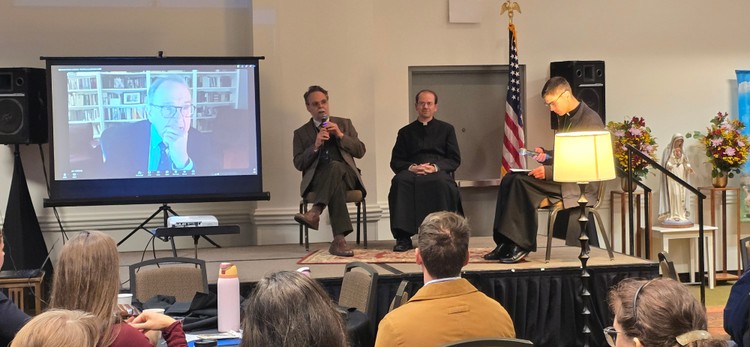
"The Roman Catholic religion, then, is necessary to sustain popular liberty, because popular liberty can be sustained only by a religion free from popular control above the people speaking from above and able to command them."
In his afternoon talk, "The Myth of the Phantom Heresy," Ferrara traced late-19th-century debates over "Americanism," examining how figures like Archbishop John Ireland sought to align Catholic institutions with secular public education and pluralistic democracy, a movement ultimately rebuked by Pope Leo XIII in 1899.
Civic prudence and local community engagement
Fr. Jonathan Loop, SSPX—who previously served as pastor of Our Lady of Fatima in Vancouver before his current assignment as prior of St. Therese Chapel in Nicholville, New York, returned to the Northwest to deliver two addresses focusing on practical civic engagement.
In "Christ the King and Political Prudence," Fr. Loop drew upon St. Thomas Aquinas to discuss how Christians should engage with modern political realities without compromising core moral convictions. Warning against total withdrawal from civic life, he encouraged attendees to focus on family leadership, education, and patient cultural renewal.
"All profound change takes place in the silent depths of human minds and hearts," Fr. Loop said. "We have to be patient. We're facing a very long project, humanly speaking... So we have to be dedicated to promoting that, just like the enemies of the Church were very dedicated and patient and persistent."
In his closing address, Fr. Loop reviewed historical demographic data tracing the rapid expansion of American Catholic parishes, schools, and hospitals from 1789 through 1965, followed by sharp institutional declines in subsequent decades. Quoting Archbishop Marcel Lefebvre, he urged attendees to remain anchored in traditional worship and moral integrity as the foundation for renewing society.
Building a permanent regional gathering
The conference concluded Saturday evening with a moderated question-and-answer panel covering legal philosophy, historical leadership, and civic duty, followed by a silent auction and banquet.
With strong regional attendance and enthusiastic feedback from local parishioners and visitors alike, organizers from Our Lady of Fatima hope the 2026 event marks the beginning of an annual West Coast tradition—establishing a regular Pacific Northwest forum for Catholic scholarship, fellowship, and cultural reflection alongside major national gatherings in the Midwest.
Comments
Loading comments…