
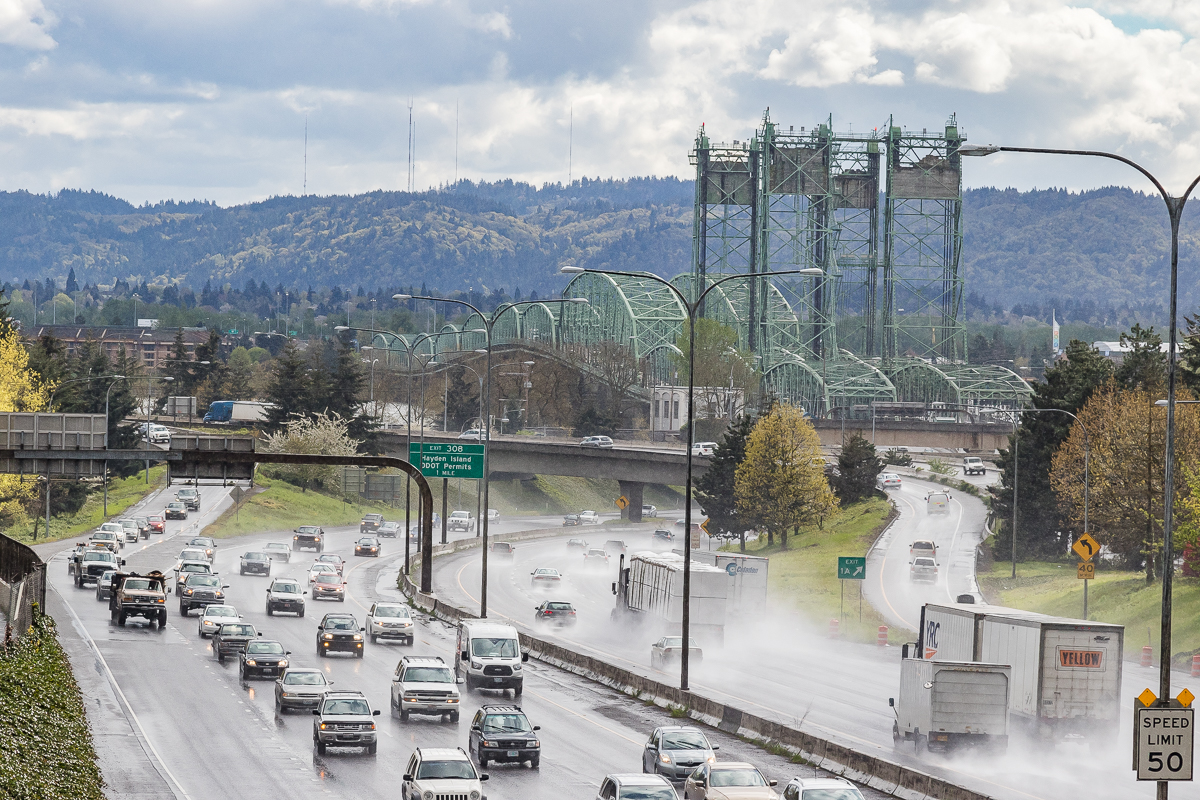
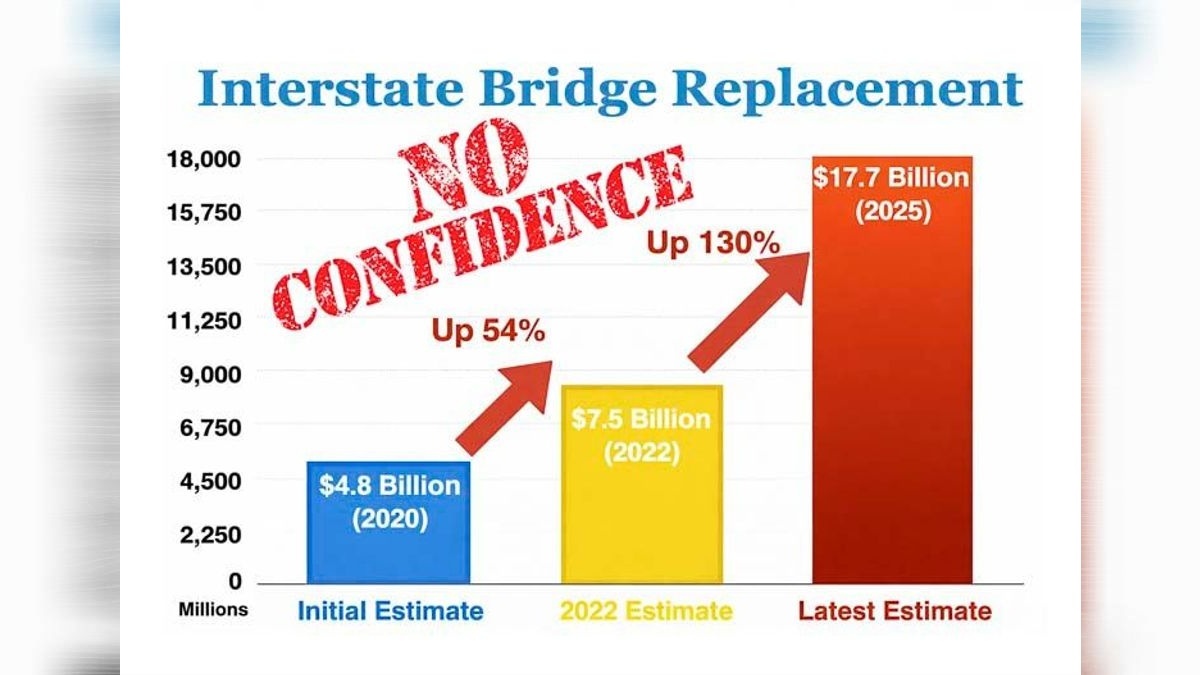
To the casual observer, the Interstate Bridge Replacement Program looks like an expensive road project meant to ease congestion on I-5 between Portland and Vancouver; however, it will not, by IBR’s own admission. To those who have followed the IBR and its predecessor, the Columbia River Crossing (CRC), it looks far more like a $15–17 billion administrative toll and tax levy imposed on Oregon and Washington residents without meaningful taxpayer oversight, voter approval, or clear public benefit.
Many longtime observers now view the IBR as a self-directed agency whose primary achievement will be locking in permanent revenue for WSDOT and ODOT through extreme tolls and higher taxes—while delivering a bridge that does little to solve the traffic problem it claims to address.
A massive bridge that blocks views and explodes in cost
The IBR plans to replace the 3,500-foot-long historic Interstate Bridge with a massive 13,200-foot (2.5-mile), 193-foot-high structure stretching from Delta Park in Portland to near East Evergreen Boulevard in Vancouver. The new span will pass over Hayden Island at 35–45 feet above ground level (AGL) and Vancouver at 95–100 feet AGL, permanently blocking views of Mount Hood for many residents. For years, the IBR insisted the project would cost only $4–6 billion. Only after an independent Oregon journalist forced the issue in 2025 did officials concede the true range had climbed to $13–17 billion. Cost overruns and ODOT/WSDOT mismanagement could easily push the total past $30 billion.
IBR’s real goal: Toll revenue, not congestion relief
Both the failed Columbia River Crossing and the current IBR demanded that TriMet's MAX light rail be part of the project. The current price tag is close to $3.5 billion for the "transit component," according to staff. The estimated CRC project cost, including the bridge and light rail, was $3.5 billion. Today, that's just the price tag of the light rail, in a $15 billion boondoggle. An Oregon Supreme Court Justice labeled the CRC "a light rail project in search of a bridge,” and the Administrator of the Federal Highway Administration (FHWA) Oregon Division also said the CRC was nothing more than "a platform for light rail".
The IBR lied in its original transit ridership projections -- 26,000 to 33,000 daily riders to justify the need for light rail. The reality is less than 1,000 people ride C-TRAN buses over the river today. But they got light rail approved as part of the locally preferred alternative. They then allocated 54 percent of the bridge surface to transit, bikes, and pedestrians. Only 46 percent was allocated to cars and freight haulers, showing their disdain for resolving traffic congestion. The result is that morning travel times from Salmon Creek to the Fremont Bridge will double, going from 29 minutes today to 60 minutes in 2045. Reducing traffic congestion and saving travel time is the people's top priority. The IBR proposal ignores the people's desire to save time and not be delayed in traffic.
While the earlier Columbia River Crossing project was at least an attempt to fix traffic, the IBR appears structured from the start to avoid critical oversight and impose tolls without a public vote. Solving congestion was secondary. The priority was generating a large, permanent revenue stream for the two state transportation departments. Once tolls are established on I-5, many residents expect attention to shift to tolling the I-205 Glenn Jackson Bridge as well.
Both ODOT and WSDOT have long records of delays and overruns. The CRC alone spent roughly $200 million before collapsing in 2013 under criticism of its design and lack of funding. A more recent example is ODOT’s Abernethy Bridge project: begun in 2022 with a $250 million estimate and a 2025 completion target, it is now projected at $885 million and completion in 2028.
In 2019, the same agencies relaunched the effort under the IBR name. They installed many of the same leaders—Kris Strickler, Carley Francis, Frank Green, and others—who had held key roles in the failed CRC. After spending more than $300 million, IBR Administrator Greg Johnson eventually admitted that the “new” design was essentially the old CRC design and would not solve congestion. Johnson soon departed.
OWLAC: From promised taxpayer watchdog to protective IBR guard dog
When the IBR was created, organizers also established the Joint Oregon-Washington Legislative Action Committee (OWLAC). It was presented as the oversight body that would protect taxpayer interests. In reality, it was structured to lack the citizen participation, technical expertise, and veto authority that the CRC’s Project Sponsors Council possessed.
CRC’s taxpayer oversight included citizen co-chairs, state transportation directors, city mayors, and regional agency leaders, plus the power to block decisions. The OWLAC lacks that taxpayer oversight: it consists of 16 legislators appointed by political leadership—eight from each state—with no citizen or stakeholder co-chairs and no collective veto. Dissenting voices exist, but they lack authority to compel answers, order independent audits, or force course corrections.
A 23-minute video compiled from OWLAC’s September 17, 2026 meetin g (https://youtu.be/Iq151kWOyxw). It illustrates the problem:
In the video, Washington State Representative and Co-Chair Ed Orcutt defines the problem:
“I can tell you I’ve been to some of the meetings… I saw somebody running the meeting with his head down the entire time… The result didn’t look like anything I heard in testimony, and that’s why the CRC fell apart… All of the problems with the CRC that caused it to fail have not been resolved with the IBR… We should be directing them [the IBR] as to which way they should be going, not just listening to where they’ve been going.”
Retired civil engineer Bob Ortblad, MSCE MBA, with more than 40 years of experience, then testifies:
The OWLAC has failed to control WSP, the IBR’s general engineering consultant. He accused WSP of misrepresenting costs, transit ridership, seismic risk, and safety, and of producing a flawed immersed-tube-tunnel evaluation that overstated excavation volumes by millions of cubic yards. Oregon Representative Kevin Mannix objected strongly, and Washington Senator and Co-Chair Annette Cleveland called the accusations “baseless.” Yet how would they know? Neither co-chair nor the committee has conducted a serious investigation of claims raised repeatedly over seven years. No independent financial audit of the more than $325 million spent to date has been ordered.
Testimony continues with John Charles Jr., president and CEO of Cascade Policy Institute, Portland; Doug & Margaret Tweet, residents of Camas, WA; and myself. Each of us testified to serious issues that need to be addressed and resolved immediately. Surprisingly, no one discussed any of the serious issues raised in testimony at this meeting or those from previous meetings. The video ends with closing comments from Co-Chairs McLain and Cleveland praising the IBR and emphasizing that the project must move forward.
The bridge does not need replacement
The existing Interstate Bridge is listed on the National Register of Historic Places and is the youngest of 262 older Oregon and Washington spans. Engineering estimates give it another 70–100 years of service lif e. A 2006 CRC seismic study— participated in by current IBR figures Strickler and Green—concluded the bridge could be retrofitted to earthquake standards for $125–265 million, far less than the roughly $390 million budgeted simply to demolish it. Instead, Strickler, Green, and the IBR produced a dramatic video showing the bridge collapsing in an earthquake, reinforcing the narrative that replacement is urgent.
Conflicts, opacity, and inflated justification
Greg Johnson, the IBR’s first administrator, previously served as a senior vice president at WSP USA. Shortly after his appointment, he awarded his former employer a $44 million cost-plus renewable contract without competitive bidding, guaranteeing WSP a 32 percent net profit. Because WSP USA is owned by a Canadian parent, much of that money left the country.
Transparency has been minimal. IBR concealed rising costs and its financial expenditures. It’s rejected information requests about the size & shape of its proposed bridge. Side-view renderings of the massive structure are scarce, leaving nearby residents unable to visualize the impact. For years, the project justified a light-rail extension—and therefore a 2.5-mile bridge with four stations—on WSP’s claim of 26,000–33,000 daily riders. When the Federal Highway Administration required the correct formula in 2025, ridership dropped to 4,600–5,400, a volume that bus service could handle. Rather than hold WSP accountable, the IBR granted the firm an 11th contract extension in mid-2026.
Without light rail, a shorter, less costly bridge or an immersed-tube tunnel (ITT) will save billions!
Either a short bridge or an ITT adjacent to the existing span would suffice, preserving the historic structure as a waterfront asset and saving billions. Alternatives—including the Fraser River immersed-tube tunnel under construction in British Columbia, proposals by transit architect Kevin Peterson, an d a proposed 3rd crossing—were repeatedly presented and ignored.
Insufficient navigational clearance for the US Coast Guard’s dredging vessel Yaquina to pass under IBR’s bridge. IBR’s chosen design also lowers navigational clearance by 60–62 fe et. Maritime manufacturer Iron Partners has sued, arguing the reduction permanently restricts river commerce. Even the Coast Guard’s own dredging vessel, the Yaquina, would be unable to pass at high water. Coast Guard officials on the West Coast opposed the lower clearance; approval came only after political pressure in Washington, D.C.
IBR’s new bridge will have the same 3 through-lanes and 1 auxiliary lane in each direction as exists today! Congestion will remain. Traffic experts recommend four or five through-lanes. The I-205 bridge, with four full through-lanes each way and comparable traffic volumes, already experiences daily congestion. The IBR rejected additional lanes and a third crossin g that could also serve as an evacuation route after a Cascadia earthquake.
The human cost of tolls and taxes
Assuming two crossings per da y, daily users and commuters could face roughly $2,350 a year in tolls, while freight operators would pay far more. Hayden Island’s large manufactured-home community—home to many retirees on fixed incomes—will be hit especially hard. A project of this scale creates debt that will raise taxes statewide, further increasing the cost of living in two already expensive states.
What must happen now
The IBR continues to advance an unaffordable design that will not solve congestion, protected by an oversight committee deliberately structured to exclude citizen participation and real accountability. OWLAC should be replaced immediately with a body that includes citizen and stakeholder co-chairs and genuine veto authority. That new committee must investigate the years of testimony alleging mismanagement, misrepresentation, and irregularities.
An independent engineering commission should review WSP’s ridership numbers, tunnel analysis, and role in cost concealment. Concurrent investigations by the Oregon Department of Justice, Washington Attorney General, and U.S. Department of Justice are warranted. An independent financial audit must begin at once.
Failure to act leaves both states exposed to lawsuits alleging that a multi-billion-dollar toll-and-tax scheme was advanced without proper oversight or voter consent, disguised as a road-improvement project that delivers little improvement.
Oregon and Washington taxpayers must reclaim control of the IBR, WSDOT, and ODOT.
Gary Clark is the chair of Neighbors for a Better Crossing, Inc. mailto:[email protected]


Comments
Loading comments…