
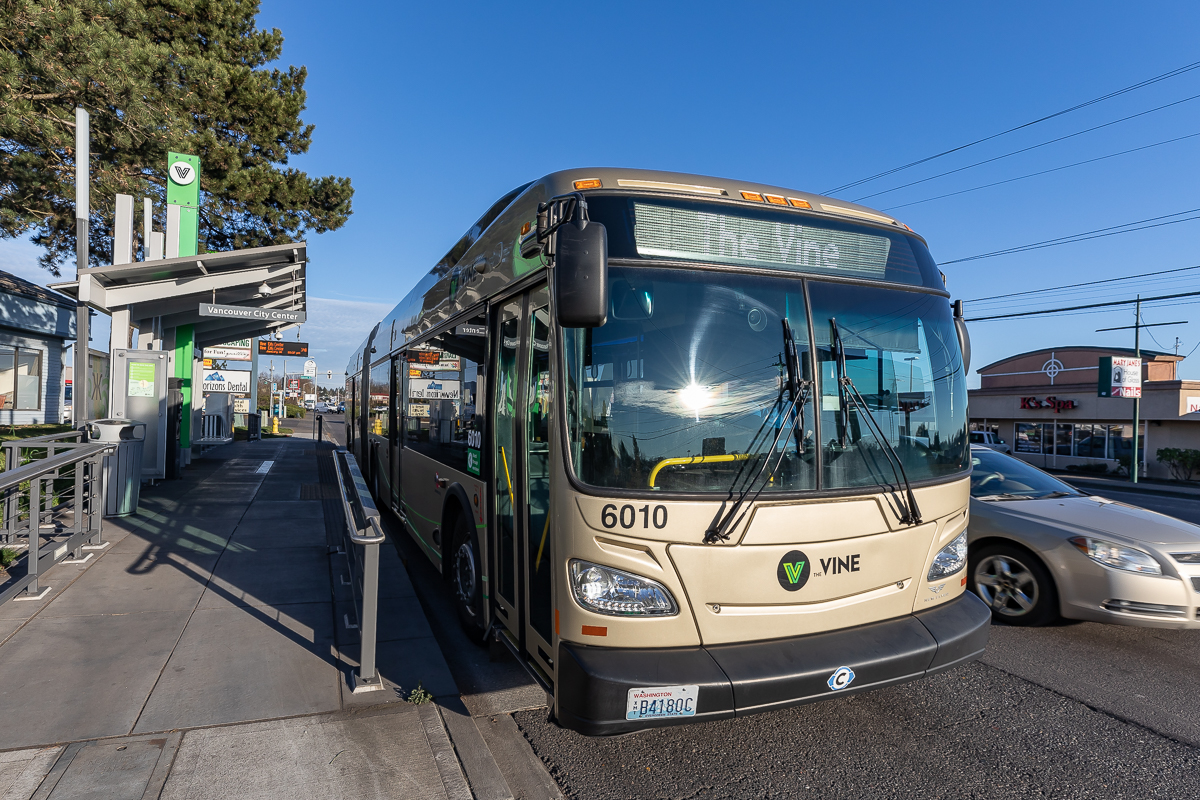
The C-TRAN Board of Directors received the latest presentation on the C-TRAN 2045 Plan on Tuesday night, and they are expected to vote on the plan at next month’s board meeting.
The recommendation from C-TRAN staff is to expand service, which would require two voter-approved tax hikes over the next 14 years.
Board member Sue Marshall, while noting she supports the recommendation, reminded her colleagues and the public that C-TRAN 2045 is simply a plan, and changes can be made.
“In the next 20 years, there’s a lot of uncertainty. Things will come up. The plan will be implemented as the public supports it,” Marshall said. “Without a plan, we don’t have a road map at all.”
Marshall added that if the C-TRAN 2045 plan is adopted, this board, and future boards, will focus on the details in the coming decades.
C-TRAN has been working on the 2045 Plan for a couple of years, receiving feedback from riders and community leaders.
At Tuesday’s board meeting, Taylor Eidt, director of planning and service delivery for C-TRAN, reiterated three options for the 2045 Plan.
- Reduce: C-TRAN currently receives 0.7 percent from the sales tax. By remaining at that number, C-TRAN would have to reduce current service.
“This scenario represents a significant degradation of service that would raise household transportation costs, increase congestion, and reduce access to opportunity in the county,” Eidt said. - Maintain: C-TRAN asks voters to approve an increase in the sales tax to 0.9 percent. That would allow staff to maintain current service levels.
“In a fast-growing county … standing still operationally effectively means that we can’t keep up with a growing community and a growing community needs,” Eidt said. - Growth: C-TRAN asks voters to approve an increase in sales tax to 0.9 percent, likely in 2030. And then ask voters to approve an increase in sales tax to 1.1 percent, likely in 2040. That would allow staff to approve new routes and expand current routes, 15-minute or less frequency on five routes, new capital projects to support service improvements, and more.
“The growth scenario is the recommended path forward. It delivers the service and improvements that the community asked for through our community-engagement periods,” Eidt said.
To see more highlights from the presentation, go to: https://www.catchthevine.com/media/uploads/board/2026/11102026_Long_Range_Plan_Update_for_Board_11.10.2026.pdf
Board member Tim Hein said he has concerns with asking the taxpayers to approve a tax hike. He also wants to know more for a plan on cost recovery, perhaps asking for riders to pay more for the service.
Board member Rian Davis wanted to make sure the smaller cities were being heard. It must be pointed out that Hein and Davis are the only board members representing the smaller cities that make up C-TRAN. The seven other board members are from the city of Vancouver and the Clark County Council.
Davis said he was not sure that C-TRAN is using the correct projections on growth in, say, Ridgefield or Washougal.
“Vancouver’s UGB (Urban Growth Boundary) is clearly going to be the biggest part of our service area, but just making sure (of) the focus on the smaller cities. … We have a lot of growth in our communities, and I just wanted to make sure that’s captured,” he said.
Board member Erik Paulsen, from Vancouver, read a statement, presumably from the city’s perspective.
“We continue to believe that investing in high-quality, high-frequency, high-impact transit infrastructure will not only offer travel options that Vancouverites will choose, it will also spur investment, jobs, and housing production,” Paulsen said.
He believes that high-capacity transit has returns that go beyond just riders traveling from Point A to Point B.
“These returns are largely seen in transit oriented development,” Paulsen said. “We are pleased that C-TRAN sees itself expanding beyond its traditional role as a transit provider to becoming an active co-developer of transit oriented development.”
Board member Glen Yung of Clark County asked what would happen if voters do not approve the tax increases.
Eidt said staff would address that scenario if needed.
Yung also wanted to confirm that funding for light rail is not embedded in this plan.
“This plan doesn’t embed any funding,” Eidt said. “It lays out strategies and funding mechanisms that are available to C-TRAN.”
State Representative John Ley used three minutes during public comment to issue his concerns with the 2045 Plan. He asked board members not to approve the plan.
“Why not ask passengers to pick up a larger portion of the operating costs?” Ley asked. “Roughly a dozen years ago, C-TRAN had a goal of increasing passenger fares to cover 25 percent of operating costs. If that was reasonable a decade ago, why isn’t it reasonable today?”
C-TRAN acknowledged that fares cover less than 5-percent of operating costs.
Ley noted that C-TRAN ridership peaked 27 years ago, and it has been in decline ever since.
Douglas Tweet, another critic of government spending, said this during public comment: “C-TRAN can learn to live within its means just like the rest of us.”
He also is concerned with a “bait and switch,” asking the public for funds in this plan but then using those funds for light rail.
Wil Fuentes of Clark County, who chaired Tuesday’s meeting, concluded the public hearing on the C-TRAN 2045 Plan with a reminder:
“We aren’t taking action tonight,” he said. “The 2045 Plan will come back in front of this board at the next C-TRAN board for adoption or not.”
The next C-TRAN Board of Directors meeting is scheduled for Dec. 8.
Comments
Loading comments…