
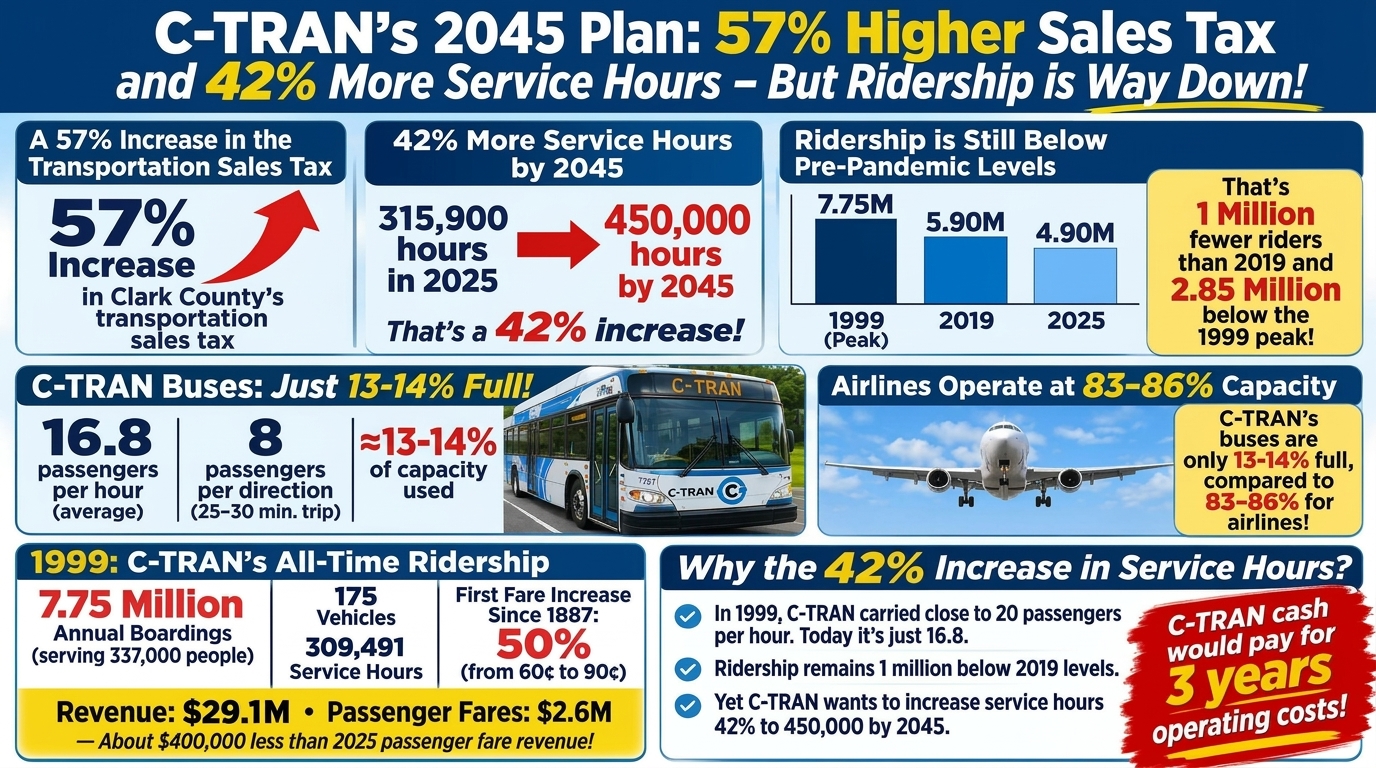
In 1999, C-TRAN carried 7.75 million passengers, the most in its 45-year history. It did that in about 309,000 fixed-route service hours, with vehicles and buses ranging from 11 to 45 passenger capacity. Clark County’s population was about 337,000. In 2025 it was about 542,000.
 Rep. John Ley
18th Legislative District
A quarter-century of growth later, the agency handles about 4.9 million boardings. That is 2.85 million below the 1999 peak and a million below 2019. C-TRAN first reached 4.9 million boardings in 1996. Ridership is back where it was 30 years ago, in a county with 200,000 more residents.
That record is the place to start with the 2045 Plan. The plan is short on relevant cost, revenue, and ridership projections. It builds its options around hours of service and treats a larger population as proof that more people will ride. The last 26 years say they will not.
The plan calls for a 57 percent increase in Clark County’s transportation sales tax and an expansion of fixed-route service from 315,900 hours in 2025 to 450,000. That is a 42 percent increase in service for a system already well below its old ridership. Major routes already run every 15 minutes, off-peak service every 30, and The Vine every 12. Buses that are mostly empty are not a reason to run them more often.
Unlimited funding plan
C-TRAN is plain about how the plan was built. “The foundation of this plan is the Vision Network,” it says. “The Vision Network is C-TRAN’s unconstrained, community-based ideal for future transit service. It represents concepts for what transit in Clark County could look like if funding were unlimited.”
Unlimited is not a standard. It is a wish list, and it arrives while costs are already running away.
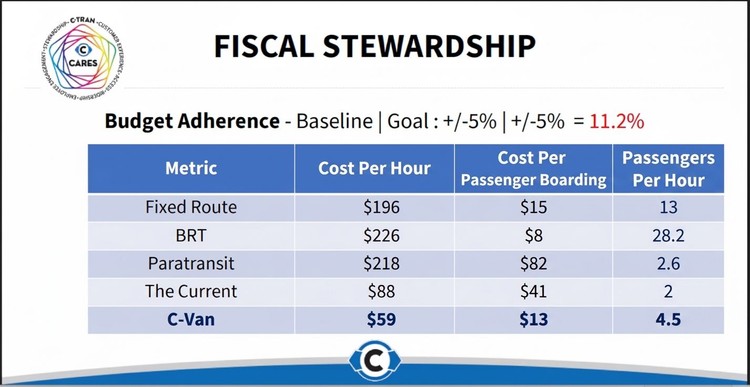
Since 2021, operating cost per hour has jumped from $156 to $218 — 39 percent in four years, about 10 percent a year. Annual operating and maintenance costs are $70.6 million, up $9 million, or more than 14 percent in a single year. Administration rose nearly 19 percent last year. That is unsustainable, and highlights a management problem and lack of Board oversight.
The service those dollars buy is thin. The average C-TRAN bus carries 13 passengers an hour; 28 on Bus Rapid Transit. On average, a one-way fixed-route trip takes 25 to 30 minutes, so a 60-passenger bus is typically carrying about eight people in each direction — filling roughly 13 percent of its capacity. More than 80 percent of seats are empty. Airlines fill 83 to 86 percent of theirs. Through the 1990s, C-TRAN buses carried close to 20 passengers an hour, and the system’s record year was run in about 6,500 fewer hours than 2025.
Fares make the same point. In 1999 the agency raised fares for the first time since 1987, from 60 cents to 90 cents. Passenger revenue was $2.6 million — only about $400,000 less than the $3 million reported in 2025, after a much larger county population and a collapse in ridership. Total revenue that year was $29.1 million.
Presently, C-TRAN has $231 million in unrestricted cash and investments. That would pay for 3 years of operating expenses, if the agency didn’t receive a single dollar from sales taxes. Passenger fares presently cover 4.2 percent of annual operating costs.
One percent of trips
Who is the proposed expansion for? About 1 to 2 percent of Clark County workers commute by transit, below the state average of about 3.4 percent, according to the Regional Transportation Council. One report called the county’s transit share “unusually low” at 1 percent of trips, down from 2.5 percent, and noted that transit lost more ground than any other mode. The ridership gains of recent years came with the Great Recession and the rebound after pandemic lockdowns. Neither approached 1999 levels.
The near-term schedule is no more convincing. The plan would add 50,000 hours by 2029, reaching 365,900, then cut 97,900 hours by 2031 for one option. It would grow service in order to cut even more of it five years later.
The “2045 System Growth” network would raise the number of fixed-route buses in peak service only from 89 in 2030 to 97 in 2045, on the way to 450,000 annual hours. There is no need to add hours now, when each bus carries 16.8 passengers an hour.
The agency laments longer travel times and says its buses “are increasingly stuck in traffic and getting slower … most often delayed in congestion while full of passengers.” Most of them are not full, and everyone else is sitting in the same traffic.
If the Regional Transportation Council pushed for more capacity and real corridors, transit would benefit along with everyone else. Instead Vancouver has been putting streets on “road diets,” removing lanes and helping provoke the Save Vancouver Streets effort. They are adding to traffic congestion.
By 2045, the technology this plan ignores is likely to matter more than another sales-tax increase. Waymo, Zoox, and other autonomous services should be offering point-to-point trips without a hired driver — safer, faster, and cheaper than the fully loaded cost of today’s transit. Self-driving shuttle buses will fill some of the gaps, and real-time data will rewrite routes and schedules. None of that is in the 2045 plan.
Cost containment is the answer. Runaway costs are the problem. The board should reject this plan and send it back. A serious plan would start from the fact that transit carries 1 to 2 percent of daily trips, that more work is done from home, and that taxpayers who rarely or never board a bus should not be asked to fund a vision written as if the money were unlimited.
Citizens have until midnight, Monday Nov. 16th to submit formal comments. Written Comments: Put “CTRAN 2045 Plan Input” in subject line submit to [email protected] or via comment form https://www.c-tran.com/c-tran2045.


Comments
Loading comments…