
Peter Bracchi
Something significant is taking shape around homelessness policy in Vancouver and Clark County.
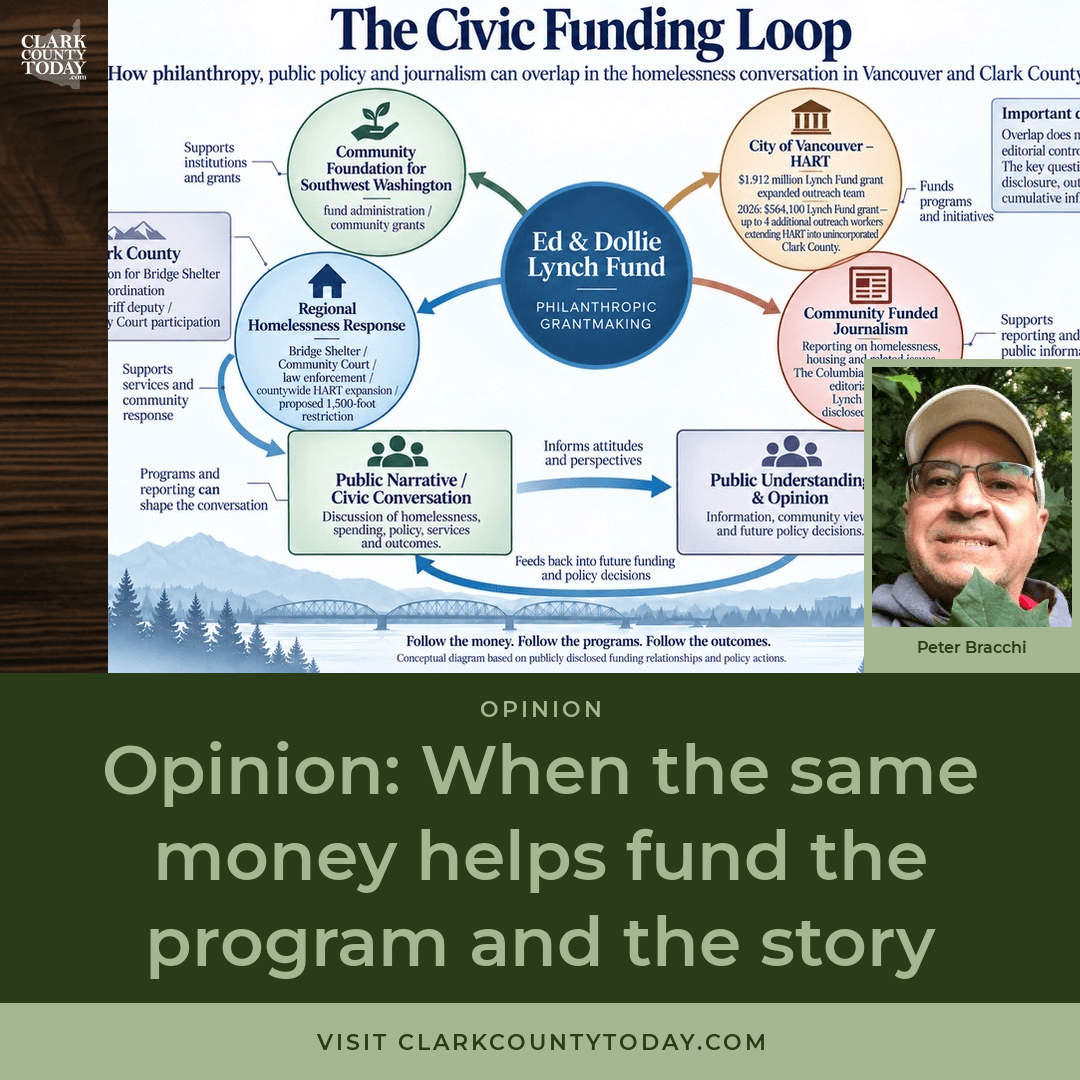
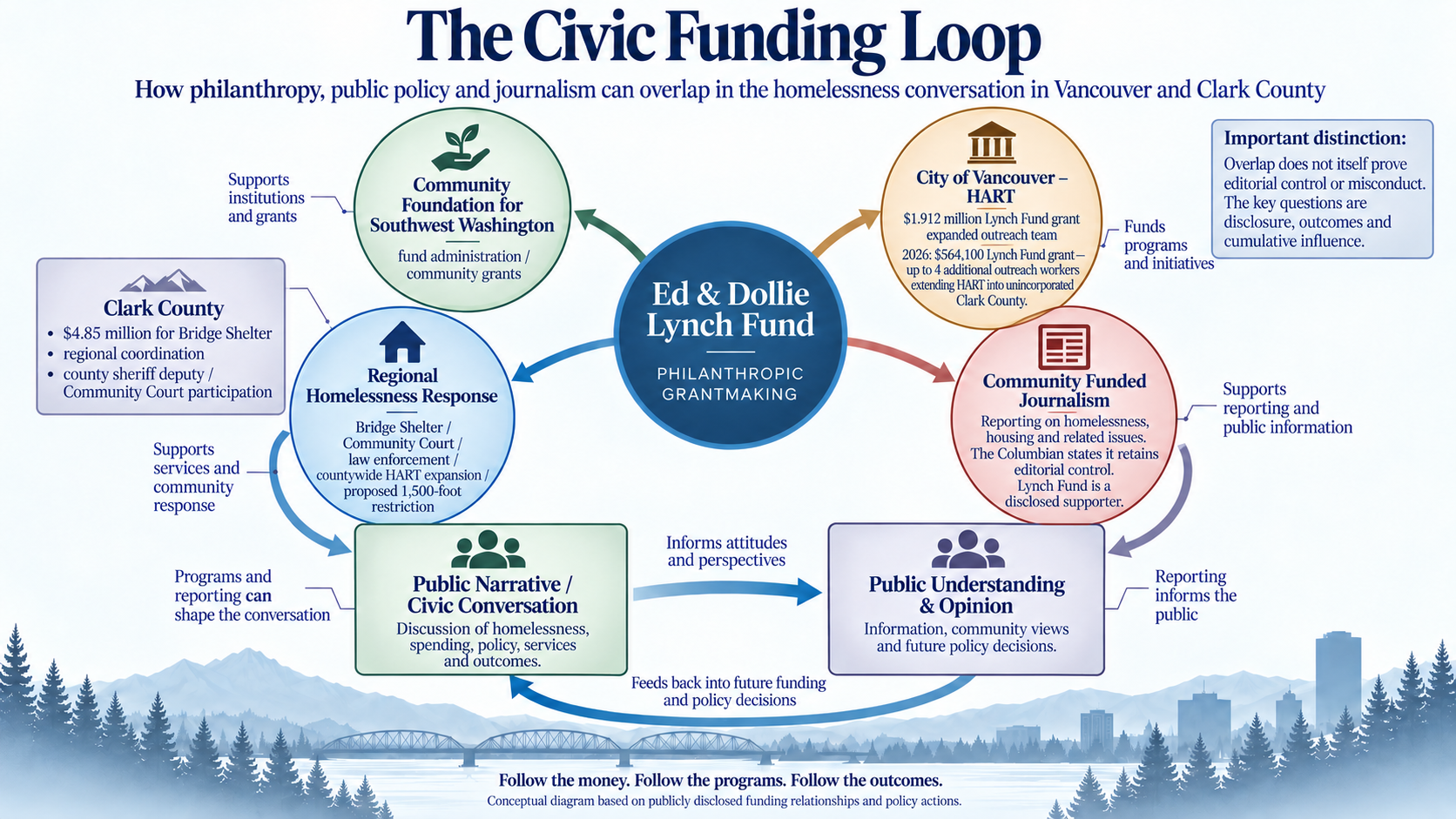
City government, county government, private philanthropy, law enforcement, shelter operators, Community Court and local journalism increasingly occupy parts of the same policy environment. Each relationship may be entirely legitimate on its own. But when the same funding sources and organizations repeatedly appear at different points in that environment, it is worth putting the pieces together so the public can see the complete picture.
The Ed and Dollie Lynch Fund provides a particularly clear example.
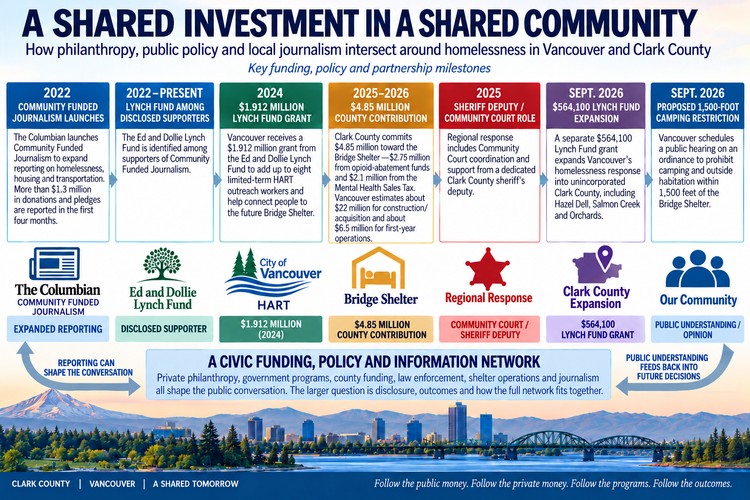
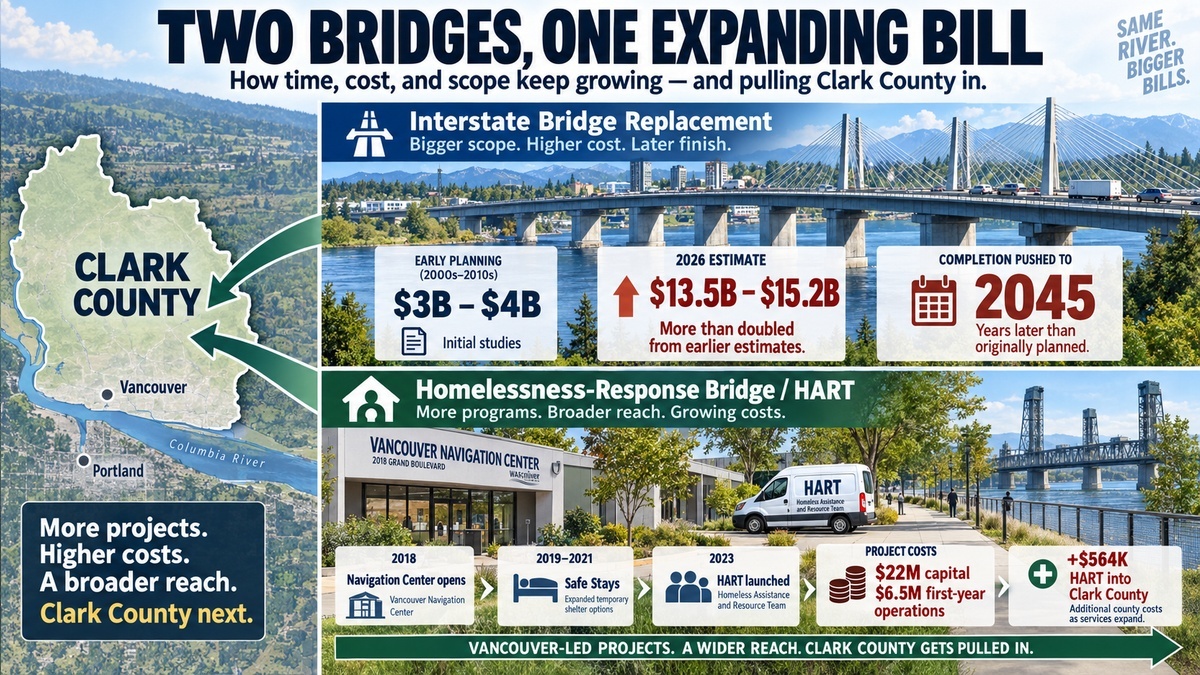
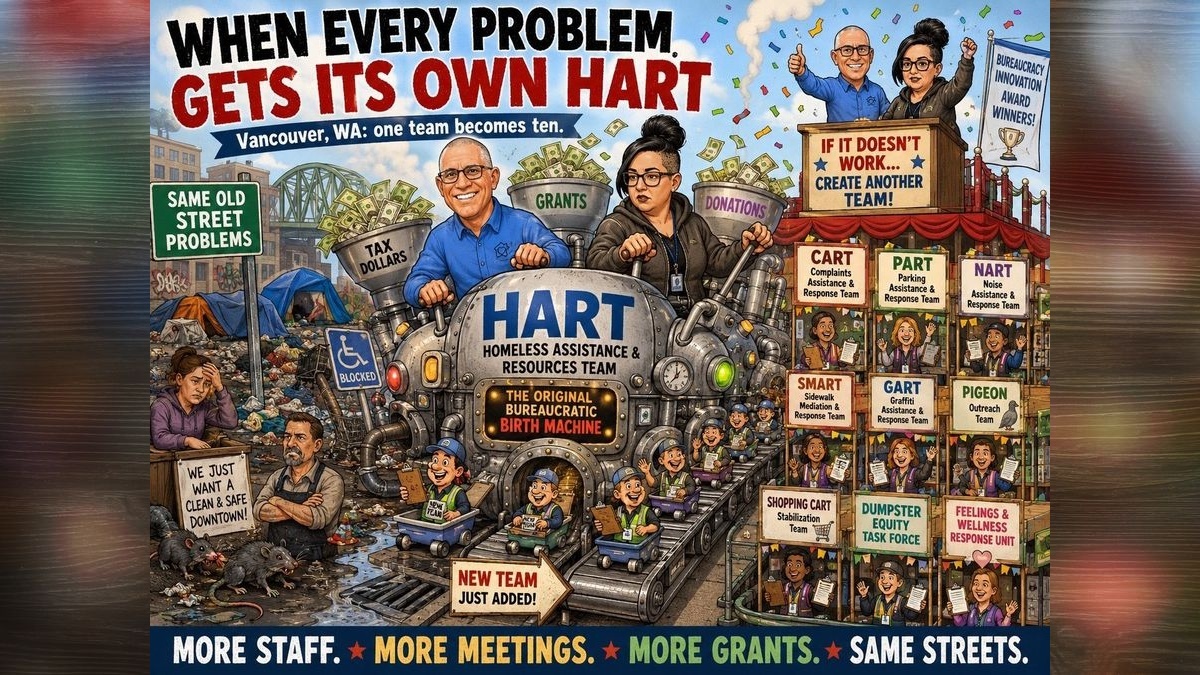
Vancouver received a $1.912 million grant from the Ed and Dollie Lynch Fund through the Community Foundation for Southwest Washington to expand the city's Homeless Assistance and Resources Team, or HART. The city said the grant could fund up to eight additional limited-term employees providing outreach and helping connect people with the future Bridge Shelter.
The Bridge Shelter has since become a much larger regional undertaking. Vancouver estimates approximately $22 millionto acquire the property and construct the shelter and about $6.5 million for first-year operations and management. Clark County has contributed $4.85 million toward the project: $2.75 million from opioid-abatement funding and $2.1 million from the county's Mental Health Sales Tax. Up to 30 percent of shelter beds are to be reserved initially for eligible Clark County residents from outside Vancouver under the city-county agreement.
Private philanthropy is now helping extend the response even farther.
In September, another $564,100 grant from the Ed and Dollie Lynch Fund was reported for up to four additional outreach positions as Vancouver expands its homelessness response into unincorporated Clark County, including areas such as Hazel Dell, Salmon Creek and Orchards. The regional approach also includes Community Court and a Clark County sheriff's deputy supporting HART-related work.
That is a substantial evolution. A city-operated outreach program supported by private philanthropy is extending across jurisdictional boundaries at the same time Clark County is investing millions of public dollars in the shelter intended to serve part of that regional population.
The policy structure is expanding as well. Vancouver has moved toward a 1,500-foot camping and outside-habitation restriction around the Bridge Shelter, adding another regulatory component to a system that already includes outreach, shelter, law enforcement and Community Court. The Bridge Shelter itself is expected to operate for at least a decade, and Vancouver has established a Business and Occupation tax dedicated to its construction and operations.
None of this is hidden. The individual pieces can be found in council records, city announcements, funding agreements and news stories.
What is less obvious is what the complete picture looks like when those pieces are placed together.
Another part of the network: journalism
The Ed and Dollie Lynch Fund also appears in another important part of the local homelessness conversation.
The Columbian launched Community Funded Journalism in 2022 to increase reporting on subjects including homelessness, housing and transportation. Local Media Association reported that the program raised more than $1.3 million in donations and pledges from 167 donors during its first four months. The Ed and Dollie Lynch Fund has subsequently been identified among the project's financial supporters.
The Columbian makes an important disclosure on Community Funded Journalism stories: the newspaper maintains editorial control over all content. Nothing I have reviewed establishes that the Lynch Fund determines which stories The Columbian publishes, selects sources for reporters or dictates editorial conclusions.
That distinction should be stated plainly.
But editorial control is not the only question worth considering. There is also the broader question of how philanthropy, public programs and the information citizens receive about those programs coexist within the same civic system.
Community Funded Journalism was specifically created to provide additional reporting capacity on subjects including homelessness and housing. Those are also areas receiving substantial philanthropic and public investment. A donor can support both activities without directing either one, but readers benefit from knowing when those financial relationships overlap.
The journalism itself is also worth examining.
A preliminary review of accessible Community Funded Journalism stories dealing with homelessness, housing, shelters and related government programs found substantial coverage explaining new programs, outreach efforts, shelter operations and public investment. Some stories also included neighborhood criticism, funding disputes and opposing viewpoints, so it would be inaccurate to characterize the reporting as uniformly supportive.
What was harder to find in that limited review was sustained, cross-program analysis asking a broader question: after years of additional spending and additional programs, what measurable outcomes are being produced for the total investment?
That is a different kind of journalism.
Reporting that HART is expanding tells readers what government is doing. Reporting that another shelter is being built explains what government is creating. Reporting another grant tells readers where additional resources are coming from.
An accountability examination would go one step further and place several years of expenditures, programs and promised outcomes alongside measurable results.
The two forms of reporting are not mutually exclusive. In fact, Community Funded Journalism was promoted as an effort to support reporting that would uncover the truth about homelessness, housing and transportation.
That makes the outcome question particularly relevant.
Put the pieces on one page
Consider the documented sequence.
A philanthropic fund helps support Community Funded Journalism. The same fund provides approximately $1.9 million for Vancouver's HART expansion. Clark County contributes $4.85 million toward a regional Bridge Shelter. Another $564,100 Lynch Fund grant expands outreach into unincorporated Clark County. County government supports adding a sheriff's deputy to the HART effort. Community Court is part of the regional response. Vancouver expands the regulatory structure surrounding the shelter. Community Funded Journalism continues reporting on homelessness, housing and the government response.
Those facts do not demonstrate editorial control, improper coordination or misconduct.
They do demonstrate substantial overlap among philanthropy, public programs and the institutions informing the public about those programs.
That is why disclosure matters.
The public does not need to assume bad motives in order to ask good questions. How much of a temporary philanthropically funded program eventually becomes a permanent taxpayer obligation? What measurable outcomes will determine whether countywide HART expansion succeeds? What happens when grant money expires? How will the Bridge Shelter's costs compare with its results over its anticipated operating life? And how aggressively will local journalism test those outcomes against the promises made when these programs were created?
Those questions apply regardless of whether someone supports or opposes the underlying homelessness policies.
The Community Foundation and the Lynch Fund have contributed substantial resources to Southwest Washington, and Vancouver openly describes philanthropic partnerships as part of its homelessness response. The city likewise publicly identifies Clark County, PeaceHealth and the Lynch Fund among the partners helping finance the Bridge Shelter system.
The issue, therefore, is not whether philanthropy is good or bad, nor whether philanthropy should help support local journalism.
The issue is visibility.
When a major philanthropic source participates in government programs while also helping support journalism covering the same policy arena, readers should be able to see both relationships and evaluate their significance for themselves.
Local journalism has traditionally encouraged citizens examining government to follow the money. In today's civic environment, that principle may need to be applied more broadly.
Follow the public money. Follow the private money. Follow the programs. Follow the outcomes. And make the relationships visible enough that citizens can reach their own conclusions.
The pieces are public.
The value comes from putting them on the same page.


Comments
Loading comments…