

 Peter Bracchi
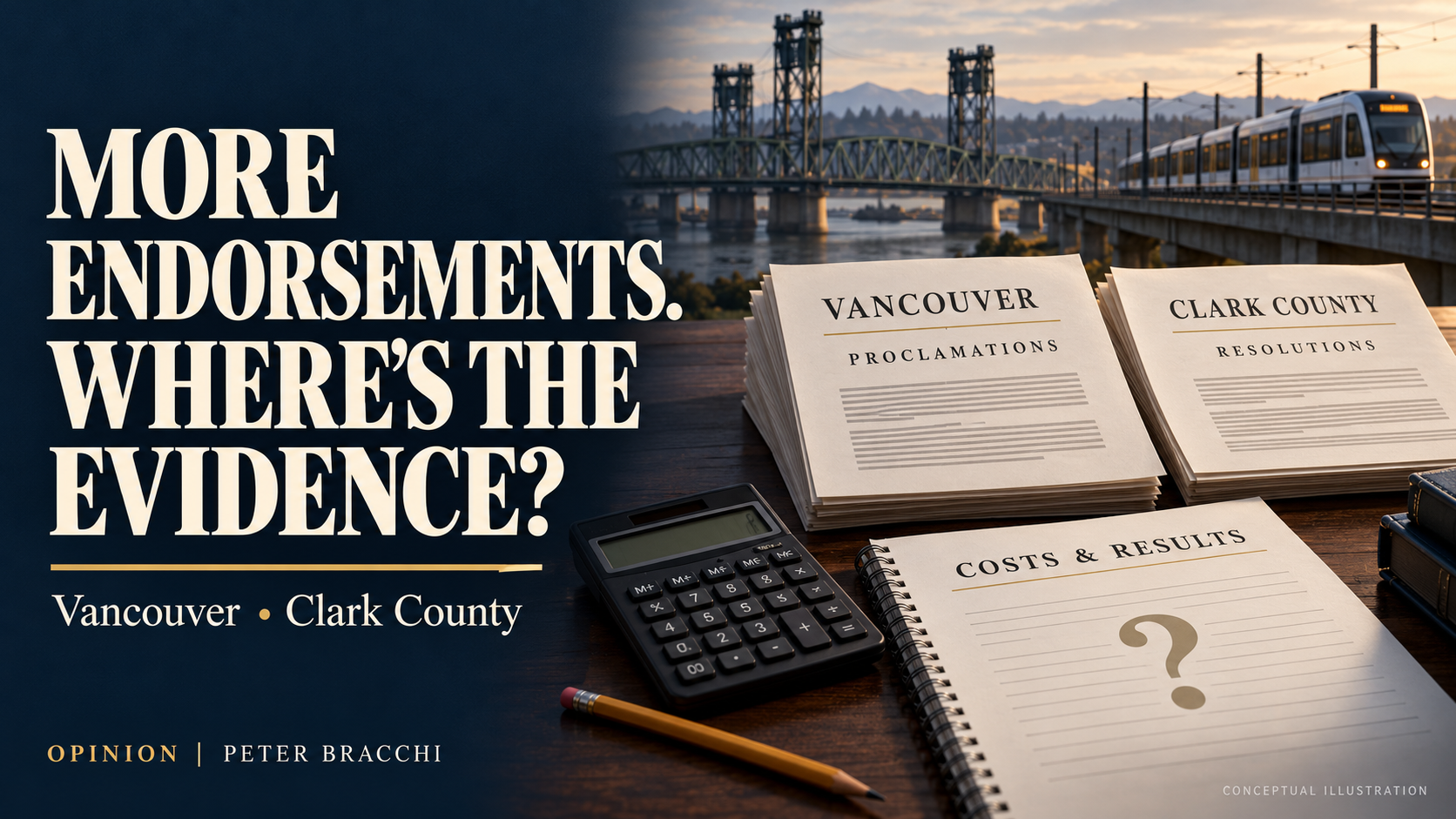
A proclamation honoring volunteers is easy to understand. A resolution supporting a major transportation investment deserves a different level of scrutiny. Clark County blurred that distinction on July 21, 2026, when a resolution advocating a specific light-rail extension appeared under “Proclamations,” alongside America250, volunteer appreciation, and lake appreciation. Councilor Wil Fuentes read the resolution during that portion of the meeting. Residents should ask why a contested infrastructure position was presented among ceremonial recognitions.
The document, Resolution 2026-07-01, strongly recommends extending light rail beyond the planned Vancouver Waterfront station to Evergreen Boulevard near Library Square. It cites Vancouver’s planning work, the proposed freeway lid, and connections with C-TRAN’s bus network. Those are arguments deserving examination. They are also unmistakably policy advocacy, carrying potential financial consequences far beyond an honorary certificate.
The resolution does not establish the additional cost of that extension, identify responsibility for its operating expenses, or present a financial comparison with alternatives. Such analysis may exist elsewhere, but this endorsement does not supply it. The county’s support should therefore prompt a straightforward question: What evidence makes this configuration worth its costs, and where can residents examine that evidence?
That question connects the county’s conduct with a broader problem at Vancouver City Hall. Official declarations can recognize community contributions, express shared aspirations, or promote a governing agenda. When those purposes blend together, a preferred policy can acquire the appearance of an agreed community value before its costs and tradeoffs have received adequate public scrutiny.
Vancouver’s own proclamation guidelines acknowledge that danger. They say a proclamation “must not take sides in matters of political, ideological or religious controversy or individual convictions.” Yet the mayor’s March 2024 International Transgender Day of Visibility proclamation criticizes unspecified “regressive measures still being pursued.” The June 2025 Pride Month proclamation urges people to “push back against those who seek to roll back our progress.”
Recognizing residents’ dignity and contributions is a legitimate civic purpose. Declaring which unnamed measures are regressive, or urging resistance to unidentified opponents, introduces political judgments. Because the mayor’s office can approve, reject, and edit proclamation language, residents deserve an explanation of how those judgments fit the city’s published restriction.
This is an apparent inconsistency requiring an answer, not an established finding of illegality. The effective date of Vancouver’s website guidelines needs to be confirmed before applying them to historical documents. Nor can Vancouver’s rules simply be imposed on Clark County. The broader accountability question, however, applies to both governments: What separates ceremonial recognition from official persuasion, and who is responsible for enforcing that distinction?
The county’s June 2026 Ride Transit Month proclamation provides another revealing example. It celebrates C-TRAN’s service and cites increased ridership, but also advances an economic case for transit investment. Alongside discussion of the $42 million Highway 99 Vine project, it states that transit investment offers a five-to-one economic return. The proclamation provides no supporting calculation or citation.
Perhaps that claim comes from a broader study of transit investment. If so, officials should identify the study and explain its limits. A general industry estimate does not automatically establish the return on a particular Clark County project. Residents should not have to untangle that distinction after an attractive number has received the government’s endorsement.
Mayor Anne McEnerny-Ogle, a former mathematics teacher and department chair, should appreciate the importance of showing the work behind an answer. The same expectation belongs at the county council table. A proclamation can repeat a number, and a resolution can endorse a project, but neither substitutes for demonstrating that the assumptions hold locally.
The concern about symbolic government is not new. In March 2018, county councilors disputed the handling of a proclamation and discussed whether clearer procedures were needed. In March 2026, Charter Review Commissioner John Jay proposed restricting symbolic political proclamations and resolutions unrelated to county functions or responsibilities, while preserving legitimate local-policy advocacy. That proposal received only two votes at its first reading and did not advance. This was a Charter Review Commission decision, not a County Council vote.
That history shows the boundary has been questioned for years. It does not prove that every proclamation is inappropriate or that the current county council invented the practice. The county unanimously adopted a resolution addressing systemic racism and injustice in 2020, under an earlier council, and subsequently held listening sessions. There was documented follow-through. Whether those activities produced lasting improvements is a separate question requiring different evidence.
That distinction between activity and achievement belongs at the center of this debate. Recognition may matter to its recipients. Listening sessions may inform officials. Transportation endorsements may communicate a negotiating position. None should be counted automatically as proof that services improved, taxpayers received value, or the public accepted the underlying policy.
Both governments should make their standards clear. Ceremonial recognitions should be distinguishable from policy endorsements. Resolutions advocating expensive commitments should direct residents to the relevant costs, funding responsibilities, alternatives, and performance expectations. Broad economic claims should identify their sources. Officials should also explain what changing evidence would cause them to reconsider.
Residents have every right to expect accessible sidewalks, dependable public services, responsible spending, and understandable transportation decisions. Government can celebrate worthy causes while meeting those obligations. But when the public asks for evidence, another declaration of commitment is an inadequate answer.
Mayor Anne can keep beating the drum, and county councilors can join in. The volume does not establish that the direction is sound. Before another endorsement is presented as progress, both governments should show their work.




Comments
Loading comments…