

How many taxes are enough? Progressive advocates say Washington needs more progressive taxes. But we already have a progressive federal income tax. The more you earn, the higher your marginal tax rate. So why does Washington State need to add a state income tax on top of everything else?
A clear message to job creators

Nancy Churchill
Washington Democrats just stacked a 9.9% capital gains tax, a 35% death tax, and a 10% income tax in three years. The message is plain. Job creators are not wanted here. Twenty-six years of one-party rule means the direction will not change. Record revenue has not slowed spending. Democrat politicians keep spending more than they take in, and they act as if no one can stop them.
Look at what Washington already taxes. Retail sales. Use. Property. Business and Occupation. Capital gains. Real estate sales. Estates. Fuel. Alcohol. Tobacco. Cannabis. Insurance. Utilities. Hazardous substances. Leases. Litter. Oil spills. Timber. Vehicles. Solid waste. Even betting on horses. In fiscal year 2025 the state collected roughly $36.1 billion in taxes. That total does not include fees, permits, tolls, regional, county or city taxes.
The Democrat Party claims it wants a fairer tax system. But layering on tax after tax and fee after fee has done the opposite. Washington now ranks as the second-most regressive tax system in the country. The bottom 20 percent of households pay 13.8 percent of their income in state and local taxes. The top 1 percent pay 4.1 percent.
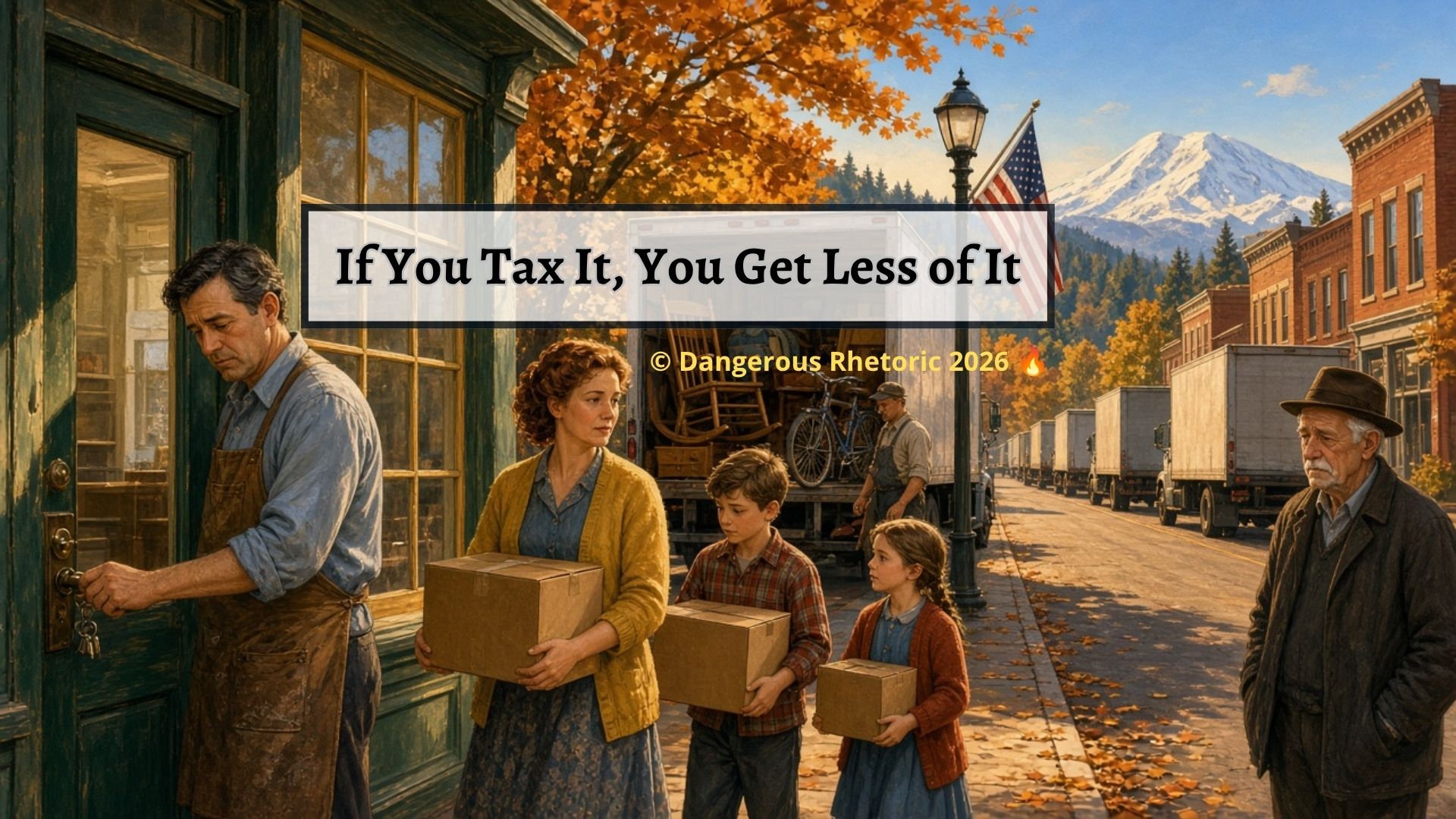
If you tax it, you get less of it
If you tax something, you get less of it. That was the reasoning for supporting sin taxes on alcohol, tobacco and marijuana.
So why would anyone want to tax income? Tax work, and you get less work. Tax payroll and you get fewer jobs. Tax success and you get fewer people willing to start and grow businesses. Tax capital gains and estates, and families keep less of what they have built.
Washington already taxes businesses on gross receipts through the B&O tax, even when a company loses money. Adding a personal income tax does not create fairness. It simply taxes work, small businesses and success one more time. The new 9.9 percent tax on income above $1 million is just another layer.
The real question is simple. Should Washington tax income when it already taxes nearly everything else?
Results, not rankings
For two decades Washington grew without a broad-based income tax. People and employers moved here. Tax collections rose. Recent tax increases—the capital gains tax, higher business taxes, and the new 9.9 percent tax on high earners—have lined up with a net loss of higher-earning residents and a sharp drop in tax competitiveness. The state fell from sixth in the 2014 index to 45th in the 2026 index.
Washington lawmakers can argue about who pays what share. They also have to face how much people will actually pay, what the changes do to the economy, and whether Washington remains a place people want to live, invest, and create jobs. After years of rapid spending growth and new tax layers, Washingtonians are finding out that higher taxes and bigger government are not working.
First, eliminate fraud.
Before adding another tax, legislators need to investigate and eliminate fraud and abuse in existing programs. A statewide audit of federal funding found an estimated $37 million in questionable child care payments and $113.3 million in likely improper payments across multiple programs.
The State Auditor’s Office has also documented major misappropriations, including nearly $900,000 stolen through fraudulent credit card use at one state agency. During the pandemic, the Employment Security Department paid roughly $647 million in fraudulent unemployment benefits.
Taxpayers should not face new taxes until officials clean up the waste and fraud already in the system.
I-645 would repeal the new income tax and prohibit future state and local taxes on individual income. Before adding another tax, shouldn’t we examine whether existing revenue is spent effectively?
Time to choose
Demand that any future tax talk start from one principle: if you tax it, you get less of it.
Support candidates who choose growth over endless spending. Local control and citizen involvement matter. Families keep more of what they earn when government stops stacking taxes without accountability.
Washington does not have to keep heading in the same direction.
Job creators can stay. Families can build. Individual votes become big change when people act together. It’s time for a change in tax policy. Vote to save what makes Washington a place where people want to live and work.
Vote Yes to Repeal the Income Tax.
Nancy Churchill is a writer, educator, and conservative activist in rural eastern Washington state. She chairs the Ferry County Republican Party and advocates for effective citizen influence through Influencing Olympia Effectively. She may be reached at [email protected]. The opinions expressed in Dangerous Rhetoric are her own. Dangerous Rhetoric is available on Substack and X.




Comments
Loading comments…