
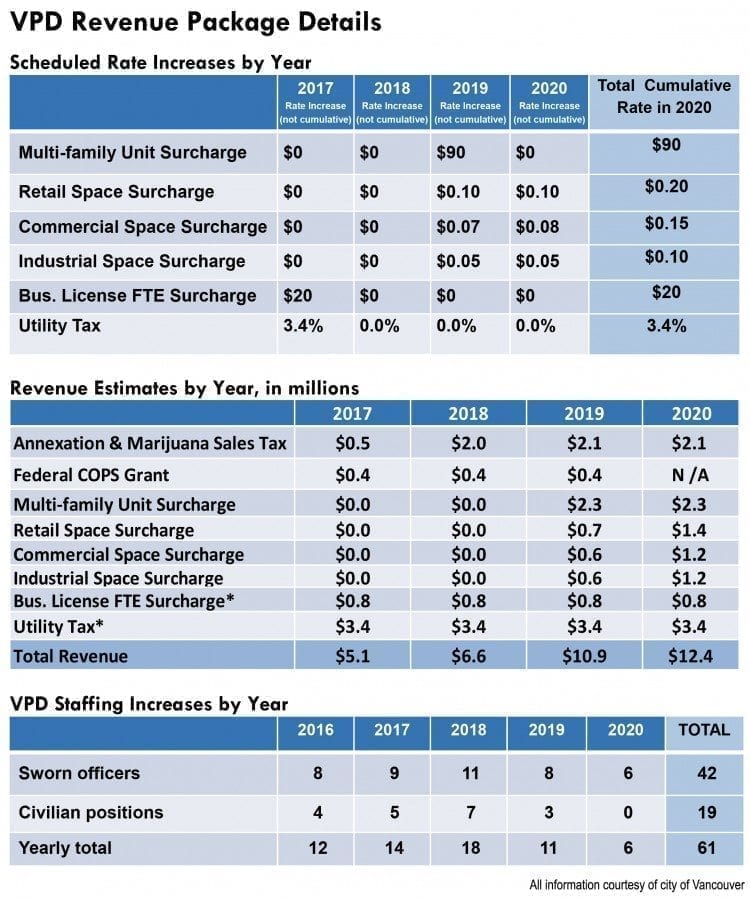
- The city’s share of the marijuana sales tax — This money is already allocated and will provide roughly $500,000 a year to the city of Vancouver for police funding.
- The federal COPS grant — Another already-existing funding source, this bridge-funding grant will provide three years’ worth of police funding and provide $400,000 a year in 2017, 2018 and 2019.
- Tax revenues from the city’s proposed Van Mall North annexation — This revenue stream is still in the works, but the Community Resource Team estimated that the new tax revenues from the annexation will provide about $1.5 million annually, beginning in 2018.
- An increase in the city’s already existing Business Tax Surcharge — This surcharge already exists, but the increase would provide an estimated $800,000 annually by 2020.
- An increase in the Utility Tax Rate on city-owned utilities — The city has one of the lowest utility tax rates in the region and the proposed increase would make Vancouver more comparable to utility tax rates in other similarly sized areas and generate about $3.4 million in new revenues by 2020.
- An annual, per-unit surcharge on Multifamily Residential Developments within the city of Vancouver — This new fee will be charged to the owners of multifamily residential developments and they may or may not pass the fees on to their renters. Under the option passed Monday night by the Vancouver City Council, this new fee will charge nothing in 2017 and 2018, then charge $90 per unit per year in 2019. The surcharge is expected to collect $2.3 million in new revenues by 2020.
- An annual per-square-foot Surcharge on Retail/Commercial/Industrial Spaces — One of the more contentious new revenue streams in the police-funding package, this fee will impact owners of retail, commercial and/or industrial space within the city of Vancouver by placing a surcharge on indoor space by the square foot. The first 5,000 square feet of space is exempt. This new fee will go into effect in 2019 and is expected to collect $1.4 million in revenue from retail spaces, $1.2 million from commercial spaces and $1.2 million from industrial spaces by 2020.
Business leaders concerned over proposal to charge ‘indoor space surcharge’ on Vancouver’s retail, commercial and industrial spaces Published on Feb. 6, 2017 By Kelly Moyer
Vancouver police receive ‘very substantial’ grant award to hire 10 new officers Published Oct. 6, 2016 By Kelly Moyer The problem, Vancouver leaders said then, is that the money to expand staffing within the Vancouver Police Department is simply not in the city’s current budget. The recession, along with a state-mandated property tax cap that limits the city’s ability to tax property owners, has contributed to what city leaders call Vancouver’s “structural deficit,” or an inability to find a long-term, stable funding source for essential services like public safety. Vancouver’s assistant city attorney Brent Boger said the options developed by the CRT would help strengthen Vancouver’s ability to protect its citizens. “They confirmed that it would help build a stronger and firmer foundation for the police department moving into the future,” Boger told the city council earlier this year. The CRT had come up with two similar plans, called Option A and Option B. The only real difference between the two options was the timing and roll-out of the new revenue sources. Under Option A, the new surcharges on multifamily housing units and indoor retail/commercial/industrial spaces would have kicked in right away. Under Option B, those charges are delayed, starting in 2019, which gives the city time to educate business owners and multifamily housing landlords. After several business leaders balked at the timing of Option A and urged city leaders to implement Option B if they had to pick one — as well as look into more stable, long-term funding sources that would be spread across Vancouver’s entire taxpaying base — the city council voted on Jan. 23 to move forward with Option B and terminate Option A entirely. The police-funding package approved this week is the Option B plan, which delays the roll-out of the more controversial revenue sources. The council also approved the CRT’s recommendation that the city conduct “a comprehensive public outreach process with the goal of developing a holistic solution to long-range service and resource needs for all city services” and said they will begin that process this year. To read more about the new police-funding package or to better understand the seven-month CRT process that led to this new revenue package, visit www.cityofvancouver.us/crt.