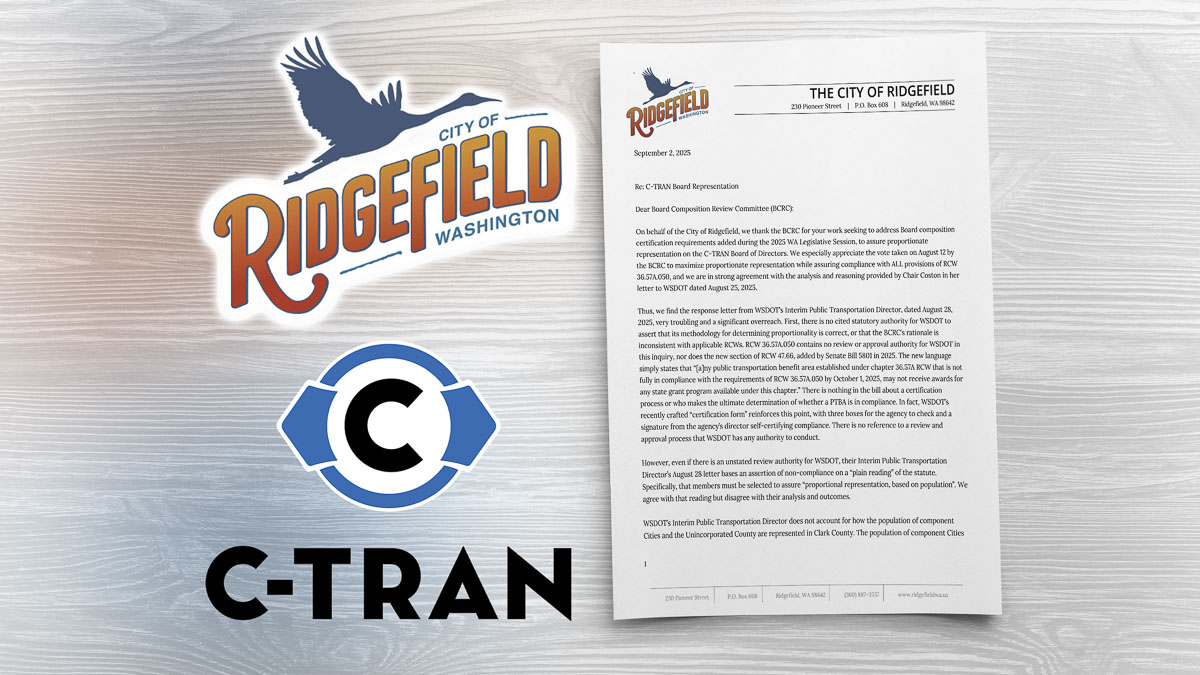

Matt Cole, the mayor of Ridgefield, wrote a letter to the C-TRAN Board Composition Review Committee asking the committee to fight for the proposed 3-3-3 compromise, saying WSDOT has no authority to deny the committee’s recommendation
Paul Valencia
Clark County Today
The city of Ridgefield appears poised to take legal action if the Washington State Department of Transportation does not OK last month’s proposal by the C-TRAN Board Composition Review Committee (BCRC) — the latest development in a battle between Vancouver and Clark County vs. the smaller cities in the county that make up C-TRAN.
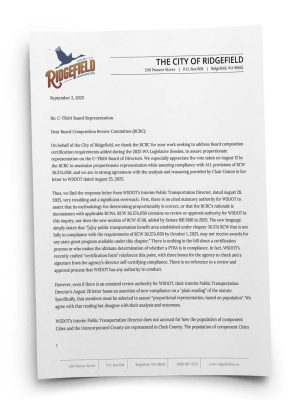
Matt Cole, the mayor of Ridgefield and a member of the review committee, wrote a letter Tuesday to the committee sharing his city’s belief that last month’s proposal from the committee should be accepted by the state.
WSDOT’s interim director for public transportation denied the proposal, which would have split the C-TRAN Board of Directors into three seats for the city of Vancouver, three to Clark County, and three to be shared by the smaller cities. WSDOT instead believes the only way C-TRAN can be in compliance with state law is if Vancouver gets four seats, the county gets three seats, and the smaller cities share two seats.
Ridgefield’s mayor disagrees.
“WSDOT’s analysis of appropriate representation by population is flawed, as it does not understand or integrate County Charter-specific representation by County Councilors. Their analysis and proposal for Board Composition create an illegal majority of representation for the City of Vancouver,” Cole wrote in his letter.
Cole told Clark County Today on Tuesday that essentially it would mean Vancouver has five seats, including one of the seats from Clark County..
The BCRC has sole authority to determine appropriate representation that meets statutory requirements, Cole noted.
“Thus, we would request that the BCRC ask that C-TRAN submits the WSDOT certification form for the 3-3-3 composition already approved at the August 12 meeting,” Cole wrote.
That 3-3-3 format would be a change to the current format, which has 3-2-4, with the small cities sharing four seats.
The committee is scheduled to meet Wednesday to determine its next steps. WSDOT has previously said that if the board remains out of compliance, it would withhold grant funding for C-TRAN.
“If WSDOT asserts authority to deny certification of the BCRC’s work and withhold grant funding, we believe C-TRAN should immediately appeal that action as inconsistent with State Law and creating harm to the agency and the people it serves,” Cole wrote.
If the BCRC chooses to adopt WSDOT’s “unlawful” suggestion — the 4-3-2 format — “the City of Ridgefield will immediately begin to evaluate our legal options, as C-TRAN’s Board of Directors would illegally allow majority representation and allocation of C-TRAN resources by representative of a single City’s population.”
Cole described WSDOT’s response to the board’s proposal to be “very troubling and a significant overreach.”
In the letter, Cole shares the research done that he says shows that a 3-3-3 composition does work and should be promoted by the review committee at Wednesday’s meeting.
C-TRAN works best when all cities are united, Cole said.
“It can’t be just Vancouver mowing over everyone,” he said. “It has to be everyone coming together, working toward a solution.”
To see the letter, click here.
- Goodbye, bumpy ride on I-5 in Vancouver
 Three coordinated WSDOT projects will improve more than 6 miles of I-5 in Clark County, backed by a $25 million investment.
 - Nighttime work on I-5 between Ridgefield and Woodland will replace damaged concrete panels Sept. 14-19
 Granite Construction will close right and center lanes nightly on I-5 between mileposts 9.5 and 21.5 through Sept. 19.
 - County seeks volunteers to serve on the Bicycle and Pedestrian Advisory Committee
 Clark County seeks two volunteers, including one youth member, for its Bicycle and Pedestrian Advisory Committee; deadline is Oct. 11, 2026.
 - Washington Rep. John Ley warns ballooning bridge budget needs reality check
 Rep. John Ley says the IBR ballooned from a $44M contract to a $13B–$15B project, with phase one still $2.2B short.
 - POLL: The IBR project is described as only 30% designed and 30% funded after more than six years of work. How confident are you in the current management of the IBR program?
 IBR’s cost has climbed from $3.2–$4.8B to $15.2B while the project remains 30% designed and 30% funded.