
During a recent debate on repealing the state income tax, opponents of I-645 claimed that the state budget's rapid expansion is driven by the Supreme Court’s McCleary decision. K–12 funding has grown rapidly since that decision, but since 2019, spending on everything else has expanded nearly three times as fast, accounting for nearly three-quarters of total state budget growth.

Ryan Frost
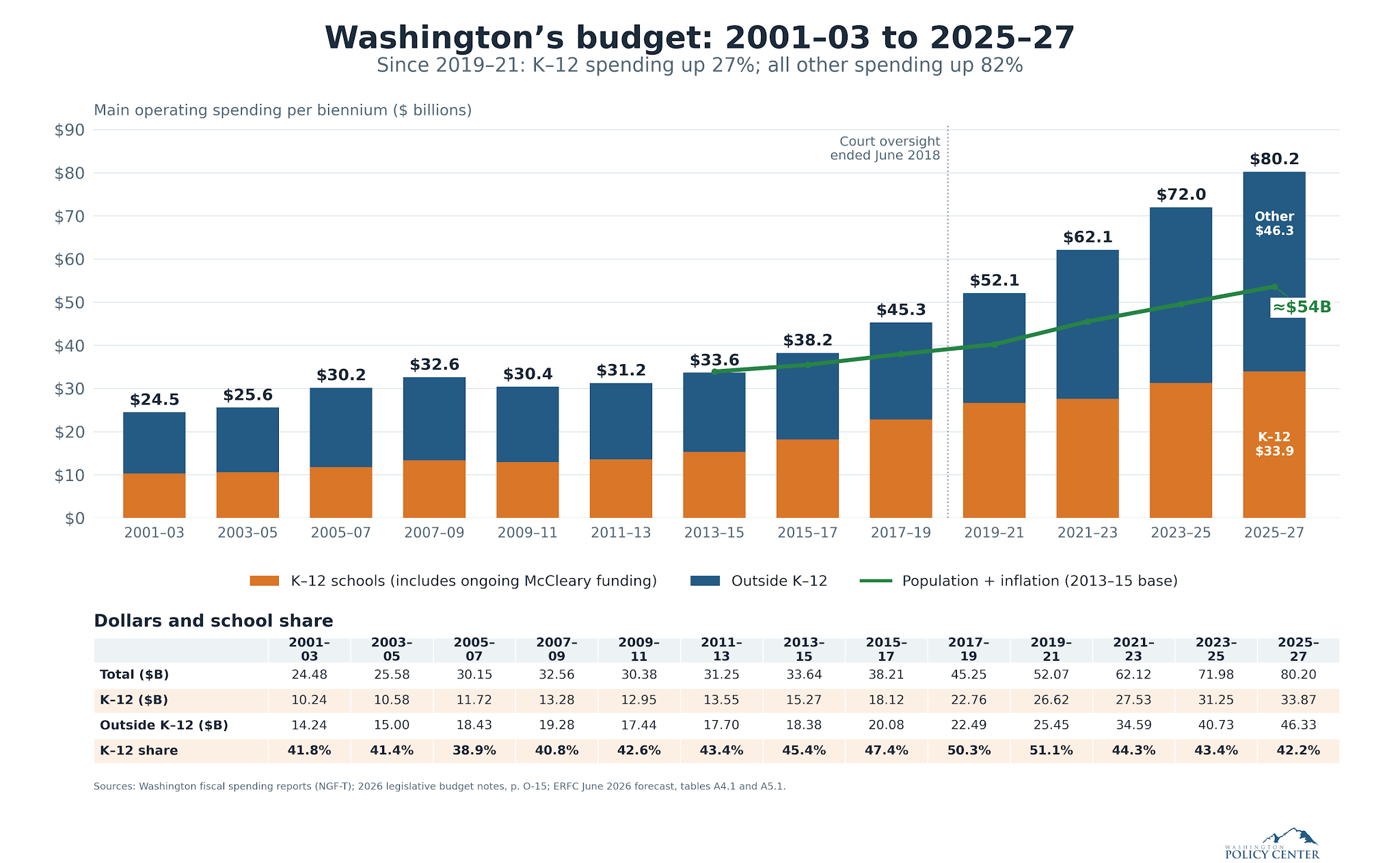 The Supreme Court formally ended its oversight of the McCleary decision in June 2018. McCleary enforced the state’s paramount constitutional duty to amply fund basic education, shifting the burden of basic operating costs and staff compensation away from local levies and onto the state budget.
By the 2019–21 biennium, the first full budget cycle post-oversight, higher school funding was already fully built into the state's spending baseline. Since then, K–12 funding has increased by $7.25 billion (27%), rising from $26.62 billion to $33.87 billion. Over the same period, non-K–12 spending surged by $20.88 billion (82%), jumping from $25.45 billion to $46.33 billion.
That represents nearly $21 billion in additional non-education spending per biennium. Even under the aggressive assumption that the entire $7.25 billion increase in K–12 funding was directly driven by McCleary compliance, 74% of the state's budget growth over this six-year period remains entirely outside public schools.
K–12 education comprised 41.8% of the budget in 2001–03, rose to 51.1% in 2019–21 following post-McCleary investments, and has since fallen back to 42.2%. This declining share does not mean schools are receiving less money, as K–12 funding is up 27%. Rather, non-education spending has expanded so rapidly (+82%) that school funding cannot keep pace proportionally.
At the same time, the state is spending more per pupil to educate fewer students. State enrollment data shows 47,484 fewer students in October 2025 than in October 2019, a 4.3% decline. Academic performance has similarly drifted: between 2019 and 2024, Washington’s average NAEP scores fell from 220 to 216 in fourth-grade reading and from 286 to 274 in eighth-grade math.
Attributing today’s state fiscal pressures to a court mandate resolved years ago sidesteps the core issue: lawmakers need to explain why the rest of state government costs $21 billion more per biennium than it did just six years ago.
Ryan Frost is the director of Budget and Tax Policy at the Washington Policy Center.



Comments
Loading comments…