

Editor’s note: Opinions expressed in this letter to the editor are those of the author alone and may not reflect the editorial position of ClarkCountyToday.com
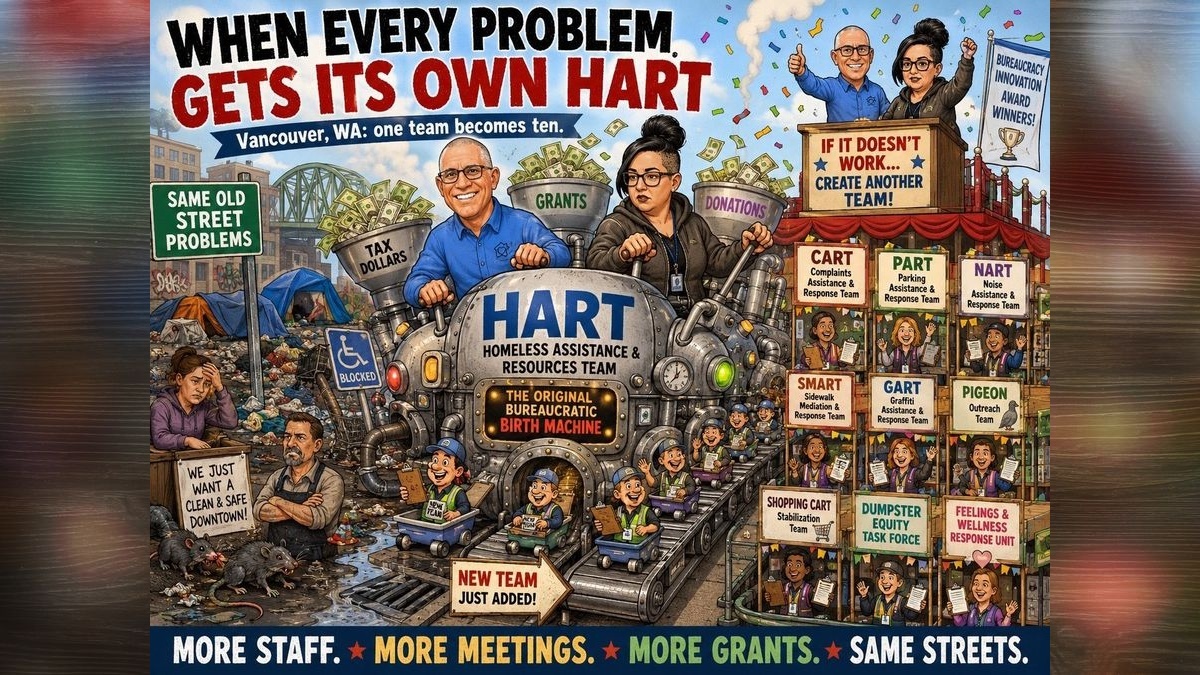
For more than a decade, the neighborhood surrounding Vancouver’s Share House has lived with recurring encampments, blocked sidewalks, garbage, sanitation problems, repeated cleanups and continuing demands on public services. The issue is no longer simply whether Vancouver has enough shelter beds for every person living outside. HART Manager Jamie Spinelli has made the reasonable point that it does not, and that clearing an encampment does not necessarily end anyone’s homelessness.

Peter Bracchi
But that explanation leaves a much narrower question unanswered:
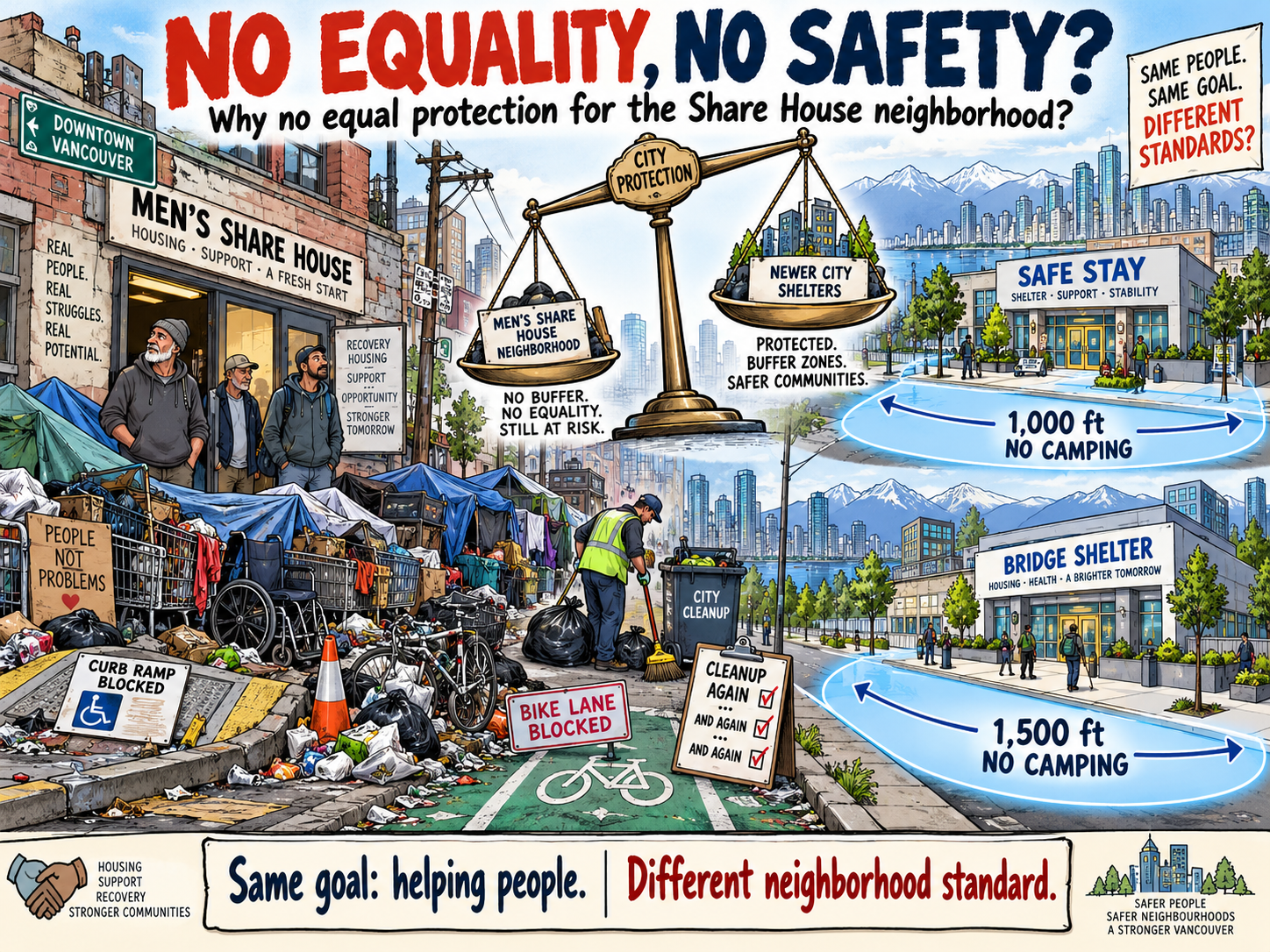
Why does Vancouver protect people living in its newer homeless programs from concentrated camping immediately outside their facilities while offering no comparable protection to the men living inside Share House?
The men living at Share House have already done what the homelessness system asks people to do. They have come indoors. They are living in a shelter and trying to move toward stability and permanent housing. Yet they walk outside into a neighborhood that has repeatedly experienced the same conditions Vancouver now deliberately tries to prevent around its newer homeless facilities.
Safe Stay communities provide managed shelter, sanitation, supportive services and 24-hour onsite management. Once a Safe Stay opens, public camping is prohibited within 1,000 feet. Vancouver says these communities are intended to provide greater stability and safe living conditions while residents transition out of homelessness.
The Bridge Shelter is being built around the same basic principle. It will provide up to 120 beds and other services, while the City has approved a 1,500-foot no-camping area around the facility.
That raises a straightforward equity question. Why should someone trying to rebuild his life at Share House receive less protection from the conditions immediately outside his shelter than someone pursuing the same goal at a Safe Stay or the Bridge Shelter?
This is not a new problem. In February 2017, Vancouver officials prepared a document titled “Share Homeless Encampment: Draft Options for Post Clean-up City Stance.” The alternatives were explicitly labeled “Containment of Encampment” and “Dispersal of Encampment.”
The containment proposal contemplated allowing camping within specified public rights-of-way near Share House, allowing tents to remain during the daytime under certain conditions, managing garbage and human waste and establishing enforcement thresholds. The document itself acknowledged that one concentrated camping area could receive a different level of enforcement than the rest of Vancouver.
The dispersal option carried a different acknowledged consequence: campers could be pushed into other parts of Vancouver and affect more neighborhoods.
Then-Vancouver Police Officer Tyler Chavers, who was directly involved with the Share encampment, wrote that Vancouver was already doing containment “by default,” described the area as an “unofficial established camp,” and said enforcement there had already been different from other areas.
City management ultimately did not formally adopt the containment proposal. It chose a firmer enforcement approach, including daytime teardown requirements and periodic VPD and Code contacts “as resources permit.” That distinction is important. But so is what happened afterward: the basic problem did not disappear.
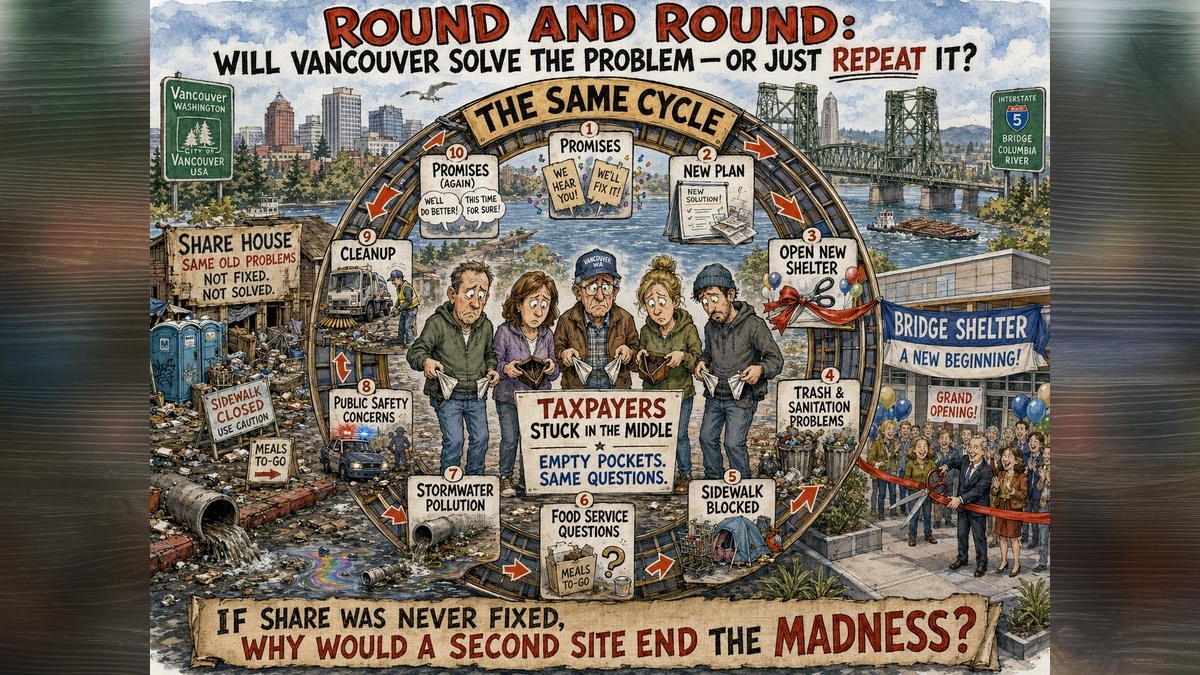
Years later, Vancouver was still reporting sanitation and safety cleanup work around Share House, and in September 2026 Clark County Today reported more than 100 tents or tarps within a few blocks of the shelter. HART itself now says the conditions are unacceptable and that the City continues working in the area.
That creates an accountability question very different from asking whether Vancouver can arrest its way out of homelessness: How long should government repeatedly manage the same conditions before asking whether the management strategy itself needs to change?
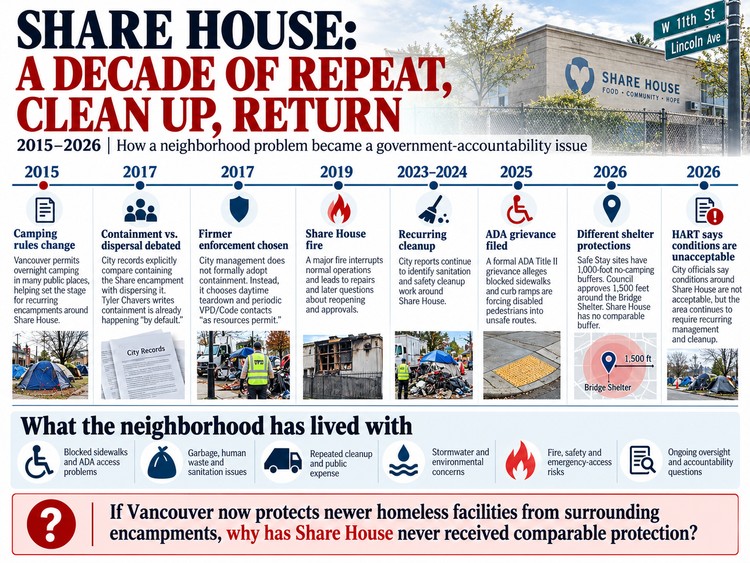
There is also a financial side to that question. Public resources have been used over the years for cleanup, waste removal, outreach, police and fire response, sanitation, code enforcement and other recurring work. I would not assign a single Share House dollar figure without separating expenditures geographically, but the response clearly is not cost-free.
A cleanup costs money. Returning later to clean the same area costs money again. When that cycle repeats for years, taxpayers have a legitimate reason to ask what lasting result is being purchased.
Vancouver’s Safe Stay program demonstrates that the City already understands an important principle: a shelter does not exist in isolation from the area surrounding it. The environment outside matters to the people living inside. It matters to neighbors, businesses, pedestrians, sanitation workers and emergency responders.
That same understanding is now being incorporated into the Bridge Shelter. Yet Share House predates those programs, and its residents and surrounding neighborhood have never received comparable protection.
Equity cannot simply be a principle applied to Vancouver’s newest programs while an older shelter and its neighborhood continue under a different practical standard. Safety also has to mean more than repeatedly clearing the same public space and watching the same unsafe conditions return.
The timing makes that question especially relevant. Vancouver says its 2026 City Council Community Forums are organized around Council priorities that include equity, safety and climate action. The Sept. 28 forum is primarily focused on issues affecting young people, but the City also says community members may discuss other concerns with council members.
Share House offers a concrete example against which those words — equity and safety — can be examined.
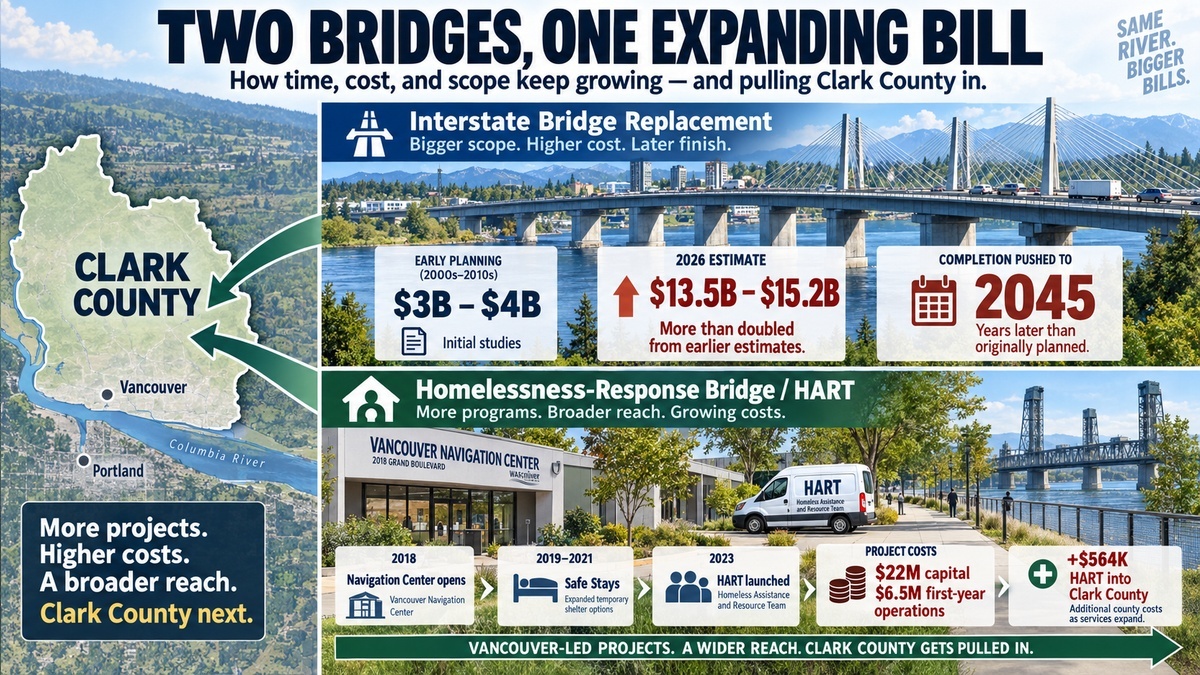
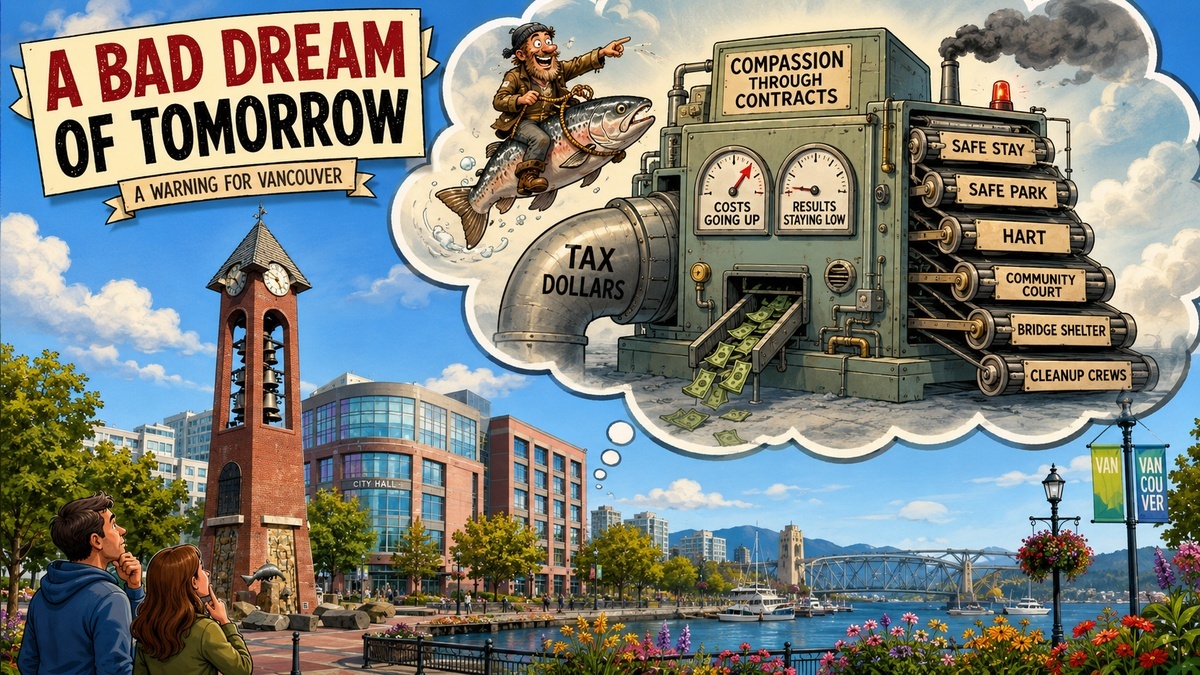
The City’s homelessness response is far larger than it was when officials debated containment and dispersal in 2017. Vancouver now has HART, four Safe Stay communities, Safe Park, expanded encampment response and a major Bridge Shelter nearing completion. The City says it has increasingly restricted outdoor habitation as it has created additional alternatives.
Yet the Share House neighborhood is still confronting a version of the same problem officials were debating nearly a decade ago.
So the question is no longer simply, “Where would everyone go?”
The more specific question is this: If the conditions surrounding Share House are unacceptable, why have they been allowed to repeatedly re-form for nearly a decade while Vancouver specifically protects its newer homeless facilities from those same conditions?
And the most important question remains the human one: When will the men living inside Share House receive the same consideration for safety, dignity and recovery that Vancouver now builds into the shelters it creates itself?
Peter Bracchi
Vancouver
Comments
Loading comments…