
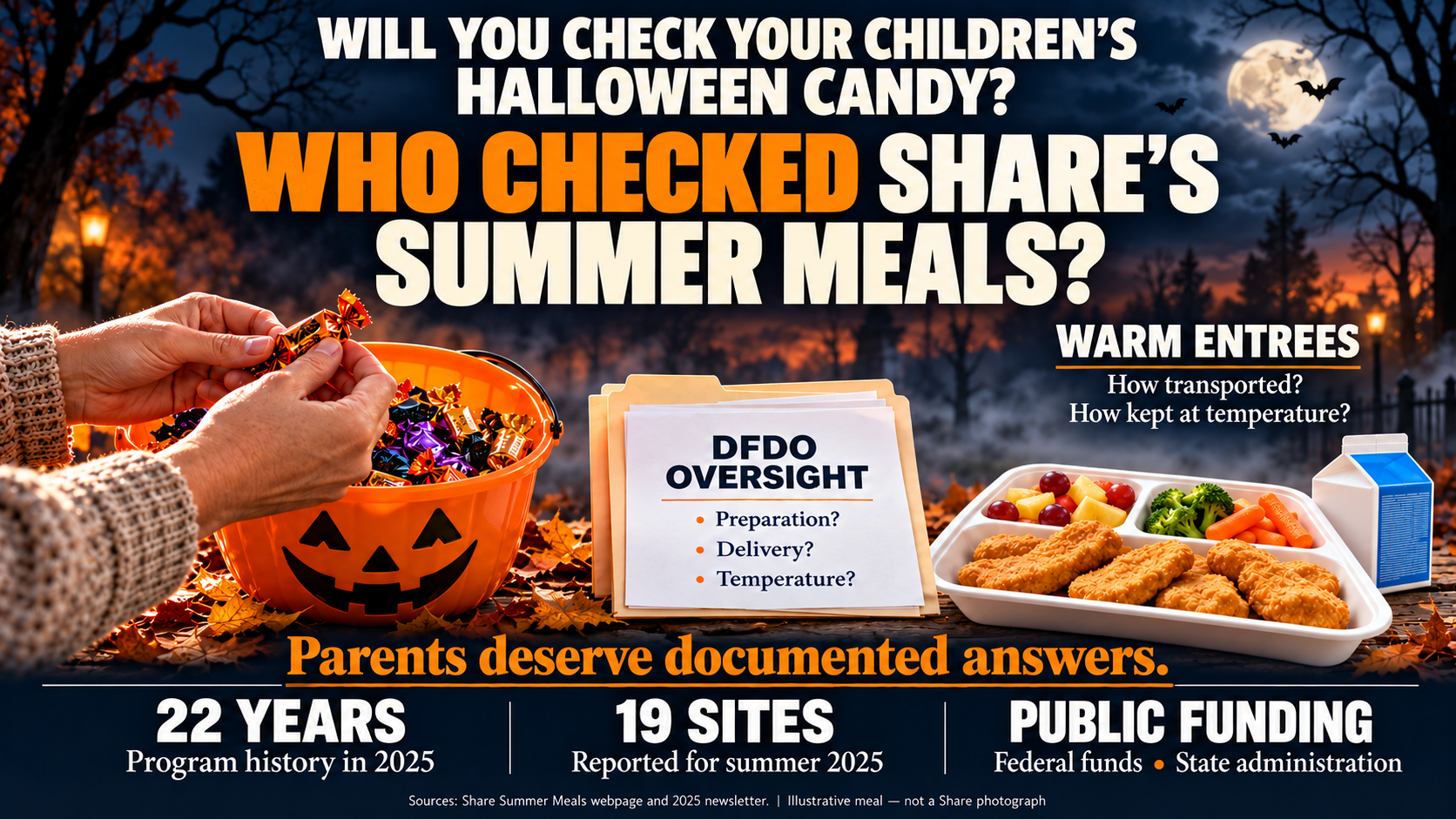
Editor’s note: Opinions expressed in this letter to the editor are those of the author alone and may not reflect the editorial position of ClarkCountyToday.com This Halloween, parents will be reminded to inspect candy wrappers, check allergy labels and watch what their children eat. Federal guidance also reminds families hosting parties to keep perishable food chilled and limit how long it sits out. Parents are expected to take responsibility.
Share and Clark County Public Health should demonstrate that same responsibility for children’s summer meals.
Peter Bracchi
Share described 2025 as its Summer Meals program’s 22nd year, serving children at 19 locations. Previously compiled reports and program summaries indicate approximately 170,000 summer meals during 2015–2024, including rounded annual figures. That excludes Share House’s separate Hot Meals operation.
Taxpayers help support this work. Share’s 2024 audited federal-awards schedule reports $61,192 under the USDA Summer Food Service Program for Children, passed through Washington’s Office of Superintendent of Public Instruction.
With that history, volume and public support, basic food-safety oversight should be easy to explain. Instead, obtaining clear authorization answers has become a months-long paperwork nightmare.
And these lunches have included more than sandwiches.
Share’s 2025 newsletter announced warm entrees: bean burritos, chicken nuggets, waffles with sausage, pizza quesadillas and corn dogs. Its archived website describes volunteers preparing and packaging meals, delivering them in coolers and distributing them at meal sites. It also links to older volunteer videos about the kitchen and cooler handling.
Those descriptions establish that food was being moved between locations. They do not explain how the newer warm entrees were kept at appropriate temperatures during transportation and service, or what Public Health reviewed.
A mother or father cannot determine that by looking at her child’s lunch. They must trust the operator and the health department.
Yet 2026 public records show discussion about establishing the summer program’s status as a Donated Food Distributing Organization, or DFDO, after years of operation. Qualifying DFDOs are exempt from the ordinary food-establishment permit requirement, but Washington’s rules require notification of activities initially, annually and when significant changes occur.
The summer-meals records reviewed show that the county supplied a current notification form on March 30, 2026. Share returned an older, March 2012 version on June 24, shortly before service began. It lacked a hot-or-cold food question included on the newer form. The county specialist’s signature and date were blank on the produced copy.
The records reviewed did not clearly establish how those omissions were resolved. Nor did the county’s summer responses provide a clear review trail for transportation and temperature procedures.
Identifying a preparation kitchen and distribution sites does not fill that gap. Requiring children to eat “on site” does not explain what happened to the food before it arrived.
These documentation gaps do not prove children received unsafe meals. They do show why general reassurance is insufficient.
Share’s executive leadership and board should provide the complete explanation, supported by Public Health’s records: what activities were authorized, by whom, under what conditions and on what date?
That explanation should cover preparation, delivery and service, and identify when incomplete documentation was corrected. Leadership changes do not erase that responsibility. Parents should not need months of records requests to learn who stands behind their children’s food.
Share’s Summer Meals program provides a valuable service. Clear, documented oversight belongs at its foundation.
This Halloween, families will be asked to check their children’s treat bags. Share and Public Health owe them equally clear answers about their children’s Summer Lunch Program.
Peter Bracchi
Vancouver

Comments
Loading comments…