
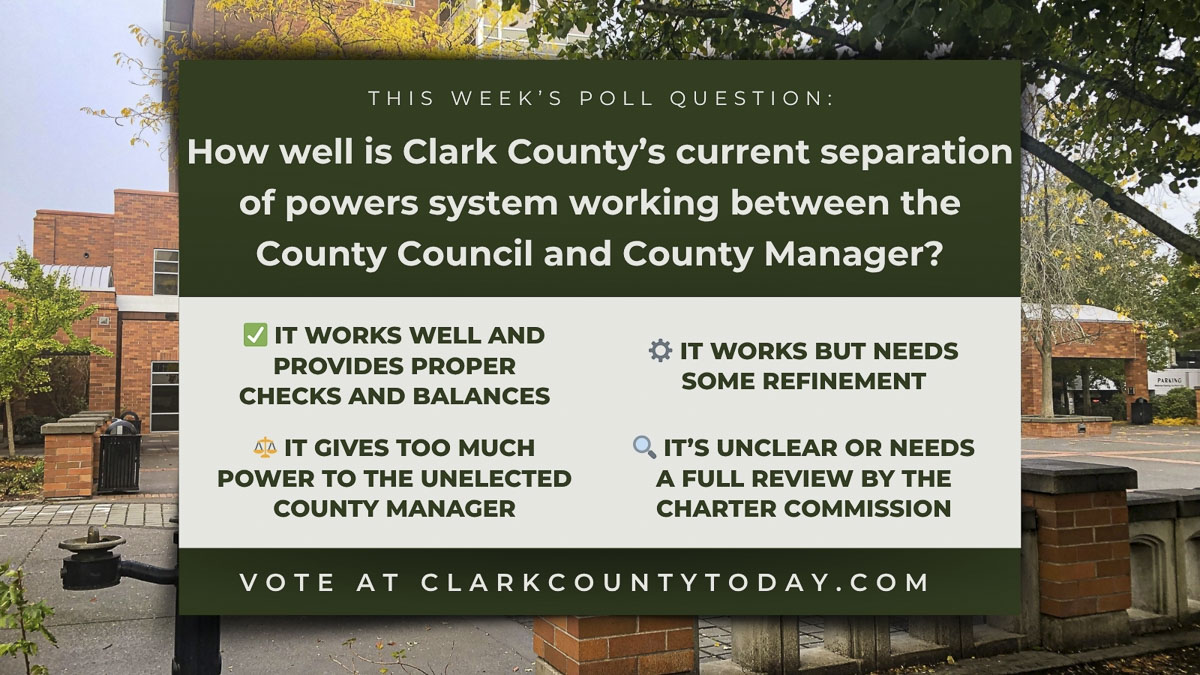
As the Charter Review Commission race highlights differing views, voters weigh in on whether the county’s balance of power is working as intended
When Clark County voters approved the Home Rule Charter in 2014, it created a clear separation between the elected County Council and the appointed County Manager — a system meant to ensure checks and balances in county government. Now, more than a decade later, candidates for the upcoming Charter Review Commission are sharply divided on whether that system still works. Some, like Cathie Garber and Duncan Hoss, say the current structure preserves transparency and prevents abuse of power. Others, including Liz Cline, Ann Donnelly, and Brad Benton, argue that too much authority has shifted to the unelected County Manager, leaving the Council with limited oversight and few resources to represent residents effectively. This week’s poll asks: how well do you think this separation of powers is working today?
More info:
Part II: Charter Review Commission candidates express positions on Separation of Powers


- Camas School District Legislative Advocacy Committee to host Candidate Forum
 Six candidates from two federal and state districts will answer education questions at Discovery High School on Oct. 5.
 - Opinion: Why lawmakers are going after your pension
 Ryan Frost argues lawmakers included public pensions in the income tax law in preparation for lowering the $1 million deduction.
 - Opinion: Washington has an income tax – why won’t the media call it one?
 Cargill argues the media is using supporters’ preferred label “millionaires tax” instead of the legally accurate term “income tax.”
 - POLL: How do you think higher impact fees for school districts affect housing affordability in Clark County?
 Clark County Council raised impact fees for La Center, Hockinson, and Woodland school districts, drawing pushback from the Building Industry Association.
 - WA high court tosses natural gas measure approved by voters
 The WA Supreme Court struck down I-2066 in a 6-3 ruling, finding it covered four distinct subjects in violation of the single-subject rule.