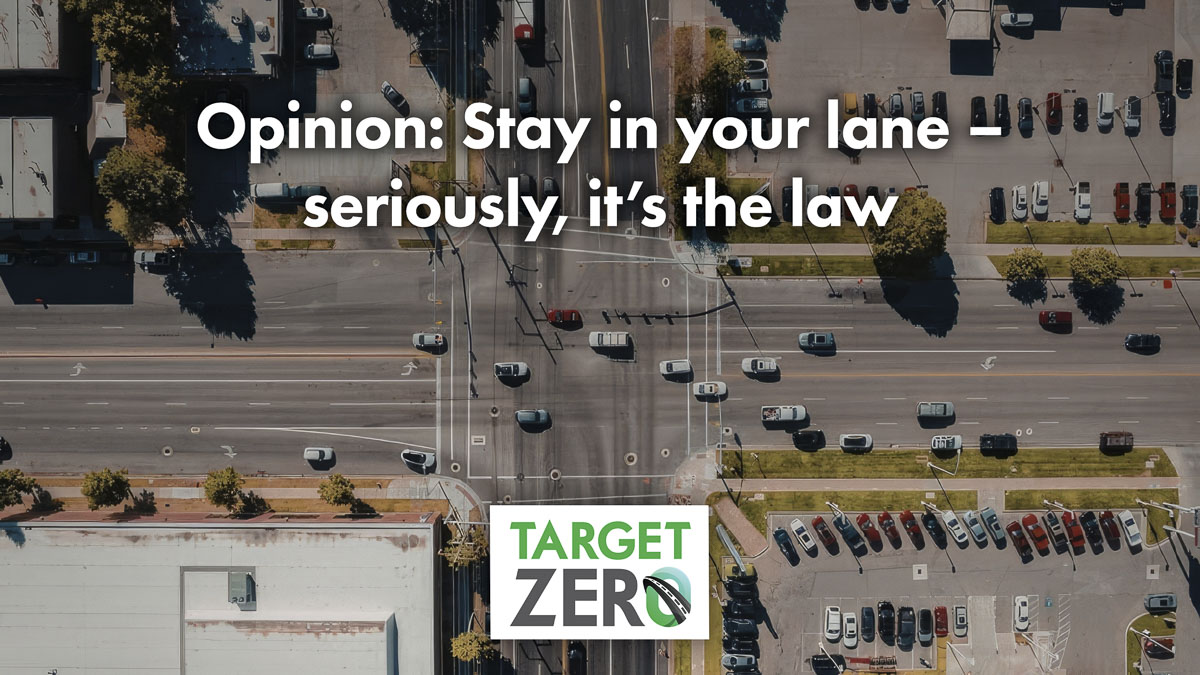
Doug Dahl says we all have a responsibility to do whatever we can to avoid a crash, even when the other driver makes a mistake
Doug Dahl
The Wise Drive
Q: Here’s the scenario: There are two cars going in opposite directions on the same roadway. One driver makes a left onto a road with two lanes of travel in either direction at the same time as the other driver is making a right onto that same road. Who has the right-of-way?
A: I’m going to assume that this intersection is controlled by a traffic signal. Yeah, I know what ‘assume’ makes out of ‘u’ and ‘me’. But if we have a road with two lanes in each direction, it’s a safe bet. Plus, we need to know what kind of traffic control each driver is facing as they approach the intersection, so let’s say it’s lights.

In a perfect world we wouldn’t need to answer this. The law has a section called “Required position and method of turning at intersections,” which the Washington Driver Guide nicely summarizes: “Whether turning left or right at an intersection, state law requires you to turn into the lane closest to the direction you are coming from.” With two lanes in each direction, both the left-turning and the right-turning driver would have a lane available to them without conflicting with the other.
But the fact that this question was asked is one more bit of evidence (as if we needed it) that we don’t live in a perfect world. If we’re looking at who to blame in a crash, we could point to the law I just mentioned and say the driver who didn’t stay in their nearest lane was at fault. That would be a good start.
It might not be that simple though. There are some other laws about turning we should consider. Let’s say both drivers have a green light. The traffic signal law states that turning drivers “shall stop to allow other vehicles lawfully within the intersection control area to complete their movements.” I suppose you could argue that if the other turning driver doesn’t stay in their lane, they’re not there legally. Still, the law makes it clear that even with a green light, drivers must yield to other cars already in the intersection.
There’s also a law specifically for left-turning drivers that says they “shall yield the right-of-way to any vehicle approaching from the opposite direction which is within the intersection or so close thereto as to constitute an immediate hazard.” The law recognizes that left turns are uniquely hazardous and puts extra responsibility on drivers turning left.
That responsibility shifts some when the driver turning right has a red light. At an intersection that permits right turns on a red light, a driver “shall remain stopped to allow other vehicles lawfully within or approaching the intersection control area to complete their movements.” Right-on-red is a higher risk maneuver, and drivers who do it have a responsibility to do it safely.
I’ll also point out that you don’t have to take a right turn on a red light. If you don’t want to take on the increased risk, you can wait for the green. If you’re concerned about delaying the drivers behind you, keep in mind that you’re not obligated to accept someone else’s higher risk tolerance for their convenience.
If I had to rank the priority of all the laws I just listed, I’d put the one about staying in the correct lane while turning at the top. If we could all follow that, we wouldn’t need to go to the rest of them. But we all have a responsibility to do whatever we can to avoid a crash, even when the other driver makes a mistake.
- Goodbye, bumpy ride on I-5 in Vancouver
 Three coordinated WSDOT projects will improve more than 6 miles of I-5 in Clark County, backed by a $25 million investment.
 - Nighttime work on I-5 between Ridgefield and Woodland will replace damaged concrete panels Sept. 14-19
 Granite Construction will close right and center lanes nightly on I-5 between mileposts 9.5 and 21.5 through Sept. 19.
 - County seeks volunteers to serve on the Bicycle and Pedestrian Advisory Committee
 Clark County seeks two volunteers, including one youth member, for its Bicycle and Pedestrian Advisory Committee; deadline is Oct. 11, 2026.
 - Washington Rep. John Ley warns ballooning bridge budget needs reality check
 Rep. John Ley says the IBR ballooned from a $44M contract to a $13B–$15B project, with phase one still $2.2B short.
 - POLL: The IBR project is described as only 30% designed and 30% funded after more than six years of work. How confident are you in the current management of the IBR program?
 IBR’s cost has climbed from $3.2–$4.8B to $15.2B while the project remains 30% designed and 30% funded.