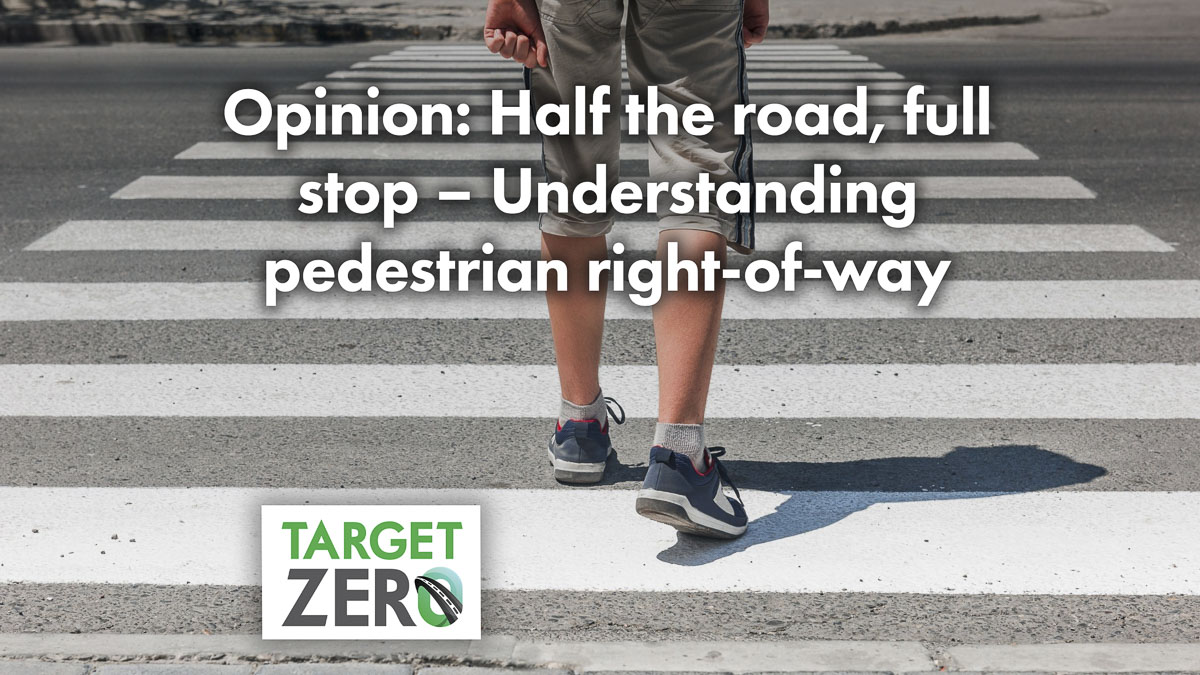
Doug Dahl says trading a few seconds for the safety of a vulnerable pedestrian is worth it
Doug Dahl
The Wise Drive
Q: How long do you have to wait after a pedestrian in a crosswalk passes your car before you can go? And if a pedestrian is coming from the other side of the street, do you have to wait for them, or can you go before they get to your lane?
A: When I was a kid, I remember arguments about which superhero was best. Is the Hulk stronger than Thor? Is Wonder Woman faster than Shazam? A few years ago the movie Batman v Superman answered one superhero riddle: if the Batmobile crashes into Superman, the Batmobile loses. (And foreshadowed in Superman II when Clark Kent got hit by a taxi and only the taxi sustained damage.)

For the rest of us, when we’re pedestrians the Batmobile and taxi are existential threats. Drivers reduce that threat when we follow the law to yield the right-of-way to pedestrians in crosswalks, marked or unmarked.
As drivers, we’re required to “stop and remain stopped” for a pedestrian (or cyclist or personal delivery device) who is “upon or within one lane of the half of the roadway upon which the vehicle is traveling or onto which it is turning.” If you’re not exactly clear about what that means, neither was I on my first reading.
First though, let’s clarify what ‘Half of the roadway’ means. It’s not ‘half’ in a geometric sense, like splitting a cookie between two five-year-olds, where if it’s not exactly 50/50 you’re going to hear about it. Half means all the lanes carrying traffic in one direction. If there’s one lane in each direction plus a left turn lane, half actually means two-thirds. When it’s a one-way street ‘half’ includes the entire width of the road.
Now, what does the law intend? We’ll start with a version most convenient for the driver: Drivers have to stop when a pedestrian is “upon or within one lane” on the half of the road where the driver is. When the pedestrian is on the other half of the roadway you’re good to go. The main problem with this interpretation, grammatically, is that it’s redundant. Why would the writers of the law use both ‘upon’ and ‘within’ if they both mean the same thing?
And there’s a reading that’s more protective for pedestrians: Drivers have to stop for pedestrians crossing on the half of the road where the driver is, plus when the pedestrian is in a lane that’s one lane away from the driver’s half of the road. As a driver, then, you’ll be stopping for pedestrians sooner, and waiting longer before you go.
So which is it? Thanks to Washington jury instructions, we don’t have to guess. For those who haven’t had the opportunity yet to sit on a jury, instructions are read to jurors to help them understand the law. For this law, the jury instructions add one word and two commas, so it reads, “either upon, or within one lane of, the half of the roadway.”
If a pedestrian is in the lane next to your half of the roadway, you need to stop and remain stopped for them. The law doesn’t make a differentiation between if the pedestrian is coming or going, so it applies even if they’ve already crossed your half of the roadway. On a road with one lane in each direction, or on a one-way road, you’re required to stop if they’re anywhere on the roadway.
To some that might seem like too much waiting around. But we’re not superhuman; trading a few seconds for the safety of a vulnerable pedestrian is worth it.
- Goodbye, bumpy ride on I-5 in Vancouver
 Three coordinated WSDOT projects will improve more than 6 miles of I-5 in Clark County, backed by a $25 million investment.
 - Nighttime work on I-5 between Ridgefield and Woodland will replace damaged concrete panels Sept. 14-19
 Granite Construction will close right and center lanes nightly on I-5 between mileposts 9.5 and 21.5 through Sept. 19.
 - County seeks volunteers to serve on the Bicycle and Pedestrian Advisory Committee
 Clark County seeks two volunteers, including one youth member, for its Bicycle and Pedestrian Advisory Committee; deadline is Oct. 11, 2026.
 - Washington Rep. John Ley warns ballooning bridge budget needs reality check
 Rep. John Ley says the IBR ballooned from a $44M contract to a $13B–$15B project, with phase one still $2.2B short.
 - POLL: The IBR project is described as only 30% designed and 30% funded after more than six years of work. How confident are you in the current management of the IBR program?
 IBR’s cost has climbed from $3.2–$4.8B to $15.2B while the project remains 30% designed and 30% funded.