




Mark Harmsworth writes that minimum wages sound compassionate, but they ignore basic economics: when labor costs spike artificially, employers reduce hiring, training, and expansion
Mark Harmsworth
Washington Policy Center
In a follow up to the Washington Policy Centers article showing the immediate negative effects of minimum wage increases in California, a new report from the National Bureau of Economic Research (NBER) has confirmed that high minimum wages means less jobs and less hours for workers.

The consequences of an aggressive $20-per-hour minimum wage for fast-food workers are now painfully clear. Assembly Bill 1228 (AB1228) enacted in September 2023 and taking full effect in April 2024, was hailed by Governor Gavin Newsom as a “win-win-win” for workers, businesses, and the economy.
The report from the NBER paints a starkly different picture: an estimated 18,000 fewer jobs in the fast-food sector alone, a direct fallout from the policy’s impact.
The NBER study, drawing on data from the Quarterly Census of Employment and Wages, reveals a 2.7% employment drop in California’s fast-food industry compared to national trends from September 2023 to September 2024. Adjusting for pre-law trajectories bumps that figure to 3.2%, underscoring how the wage hike disrupted an already fragile recovery in the sector.
These aren’t abstract numbers, they translate to real families losing entry-level opportunities, particularly for young workers who rely on these jobs as steppingstones to further education and higher paying jobs.
Preempting the hike in minimum wage, chains like Pizza Hut axed 1,200 delivery driver roles. Post-implementation, restaurant closures multiplied, and automation surged, think self-service kiosks hastily installed by franchisees desperate to reduce labor costs.
The Employment Policies Institute quantifies the human toll: non-tipped restaurant workers forfeited up to 250 hours annually, equating to $4,000 in lost wages per employee, roughly seven weeks of full-time pay.
As minimum wage increases ripple across U.S. states, policymakers elsewhere must pay attention to what the data is showing. Higher wage floors don’t magically lift all boats; they often sink the smallest vessels first, fueling inflation in menu prices and reduced hours for those who need work most.
The Washington Policy Center has long advocated market-driven solutions over top-down mandates. Minimum wages sound compassionate, but they ignore basic economics: when labor costs spike artificially, employers reduce hiring, training, and expansion. The NBER’s findings aren’t outliers, they align with decades of research showing wage floors disproportionately harm low-skill sectors like fast food, where margins are razor-thin.
It’s time for a course correction. Lawmakers should prioritize skills training, tax incentives for small businesses, and deregulation to foster genuine opportunity. California’s experiment proves that good intentions pave a road to fewer paychecks.
Mark Harmsworth is the director of the Small Business Center at the Washington Policy Center.

Also read:
- Opinion: Half the road, full stop – Understanding pedestrian right-of-way
 Doug Dahl explains how Washington’s law requires drivers to stop when a pedestrian is within one lane of their half of the road, not just when directly in front.
 - Opinion: The state’s RFK-proofing bill comes with a cost
 Mandates like HB 2242 can lead to higher premiums as insurance companies absorb costs for new preventive services, affecting affordability statewide.
 - Opinion: What is the cost of a bridge?
 John Ley argues the I-5 Bridge replacement’s soaring cost stems from costly extras like light rail, noting other states deliver larger, toll-free bridges for much less.
 - POLL: Do you agree with giving a state commission the power to remove an elected sheriff?
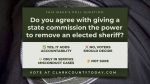 A new poll asks if a state commission—not voters—should have the power to remove an elected sheriff, following concerns raised by Clark County Sheriff John Horch.
 - Opinion: Defending Democracy by denying it?
 Washington voters are blocked from weighing in on new income taxes as state lawmakers and officials bypass public input, drawing criticism from Northwest voices.
