



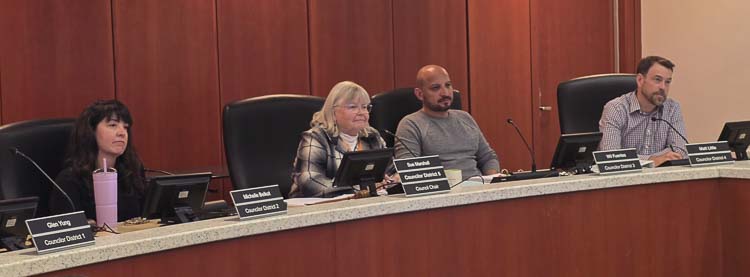
Members of the Clark County Council hear from dozens during public comment, with homeowners worried about their futures if manufactured home parks can be redeveloped, and the council agreed to extend a moratorium on redevelopment while working on a solution to the problem
Paul Valencia
Clark County Today
Owners of manufactured homes filled the Clark County Council meeting room Tuesday to share their experiences, the stress they live with due to the uncertainty of the future of the parks where they call home.
For 45 minutes, homeowners told Clark County councilors that they were concerned about being homeless if the parks were sold to landowners who want to redevelop the manufactured home parks.
They shared personal stories. Some noted how much they loved their homes, their neighbors. They wondered where they would go if they lost their homes.
One person said:
“Now I just live in fear daily that the park and/or the land will be sold, repurposed for development. If that happens, we will lose our home. Most likely we will not be able to afford what is built in the place of our manufactured homes.”
Back in August, the Clark County Council voted for a temporary moratorium on redevelopment of a park. That was to last 60 days. The clock was ticking.
Another homeowner said it was like living with a dark cloud over their homes.
“I don’t know where I would go. We all have that shadow hanging over our heads. It’s a terrible way to live.”
Those messages were received loud and clear. The four councilors who listened all came to the same conclusion: In a 4-0 vote, the council extended the moratorium for another four months (six total from the initial action in August) in hopes of giving council and county staff an opportunity to develop a more comprehensive plan to deal with the issue.
“I hold this decision very dear to my heart,” said Councilor Wil Fuentes.
He noted that roughly 2,000 homes are under this threat in Clark County.
“That’s over 5,300 people in our county, our neighbors, our family members who will be impacted if this does not get passed,” he said just prior to the vote. “In the year I’ve been on this council … this is probably one of my favorite votes, decisions that I’ve made.”
Councilor Michelle Belkot also voted yes to extend the moratorium. She noted that she responded to at least 50 emails related to the issue.
“I appreciate you bringing your concerns to my attention. I learned quite a few things,” Belkot said. “The council takes this seriously. We definitely hear your concerns, and we appreciate you so much.”
Councilor Matt Little said: “We’re with you, and we’re trying to make things work.”
Jordan Boege, senior policy analyst for the county, gave the report to the council on the current moratorium, and noted that without this vote, the moratorium would have ended in just a few days.
During questioning from the council, he clarified what the moratorium can and cannot do.
“It doesn’t stop the sale of a park. The park could still be sold,” Boege said. “However, under this moratorium, it would be required to remain a mobile home park. We would not accept any applications for redevelopment into another purpose.”
Many people who own manufactured homes own their homes but not the land. When a landowner of a mobile home park sells that land, the new owner could, essentially, evict the homeowners if the new landowner wants to create an apartment complex, for example.
That cannot happen under the moratorium, and Sue Marshall, the chair of the council, hopes a better solution can be discovered in the coming months.
“Six months isn’t a long time, but we do need to have that breathing room,” Marshall said. “Having the moratorium in place prevents development from occurring. (I) regret that you are still not totally out of the woods, but it will take us a little bit of time.”
Those in the crowd cheered when the 4-0 vote to extend the moratorium was announced.
Councilor Glen Yung recused himself from the discussion and the vote. He said he has a family member who owns a manufactured home.
There were 30 people who signed up for public comment. Because of those numbers, council voted to restrict comment to two minutes per person rather than the usual three minutes.
Also read:
- White House govt. Funding request for 2027 cuts $73 billion
 President Trump’s budget seeks to boost defense funding while cutting $73 billion from agencies like the EPA, NASA, and Agriculture, prompting sharp criticism from Democratic leaders.
 - Heywood asks WA Supreme Court to allow referendum effort on income tax
 Brian Heywood is petitioning the state Supreme Court after the Secretary of State rejected a referendum to repeal Washington’s new 9.9% tax on income over $1 million.
 - Opinion: Half the road, full stop – Understanding pedestrian right-of-way
 Doug Dahl explains how Washington’s law requires drivers to stop when a pedestrian is within one lane of their half of the road, not just when directly in front.
 - Clark County seeks volunteer for Law and Justice Council
 Applicants with experience in mental health services are encouraged to help guide Clark County’s coordination of local criminal justice and corrections planning.
 - VIDEO: Families at center of WA transgender sports debate face-to-face with OSPI
 Two Washington high school students and their parents met with Superintendent Chris Reykdal to discuss concerns about sports policies after one student faced an investigation for harassment.
 - As Washington lawmakers punt on school cellphone ban, some want more action
 At Robert Eagle Staff Middle School, all-day phone removal led to fewer conflicts and more student engagement, but some parents and lawmakers argue a ban should not be imposed statewide.
 - Opinion: The state’s RFK-proofing bill comes with a cost
 Mandates like HB 2242 can lead to higher premiums as insurance companies absorb costs for new preventive services, affecting affordability statewide.
